Showing posts with label Middle East. Show all posts

Monday, January 16, 2012

Hackers disrupt Israel airline, stock market sites

JERUSALEM (AP) — A hacker network that claims to be based in Saudi Arabia paralyzed the websites of Israel's stock exchange and national airline on Monday, escalating an international cyber war that has jolted this security-obsessed country.
Neither website contains sensitive information and trading and flights were not affected. But the ongoing salvos by hackers who use anti-Israel language in their posts has revealed how vulnerable Israel is to cyber warfare, despite its sophisticated computer security units in the military and advanced high-tech sector.

A security guard stands at the entrance of the national Israeli air carrier
El Al sales offices in Tel Aviv, Israel, Monday, Jan. 16, 2012.
Hackers disrupted the websites of Israel's stock exchange and El Al on
Monday in a deepening cyber war launched earlier this month by a group
claiming to be Saudis. (AP Photo/Ariel Schalit)
The attacks began earlier this month when hackers identifying themselves as group-xp, a known Saudi hacking group, claimed on an Israeli sports website to have gained access to 400,000 Israeli credit card accounts. The group called it a "gift to the world for the New Year" designed to "hurt the Zionist pocket."

Israeli authorities said 15,000 accounts were hacked in that episode and credit card information about 6,000 other Israelis was disclosed online a few days later by the same network.

Last week, an Israeli hacker identifying himself as a soldier in an Israeli intelligence unit retaliated by posting information online about hundreds of Saudis, Egyptians, Syrians and others.

On Monday, El Al Israel Airlines took down its website after hacker OxOmar, who has been linked to the Saudi group, warned that both sites would be targeted by allied pro-Palestinian hackers, a person close to the company said. The source was not authorized to speak to the media and requested anonymity.

The company said in a statement that it was taking security measures to protect the website and that disruptions on the site were to be expected.

Orna Goren, a spokeswoman for the Tel Aviv Stock Exchange, said the site was overwhelmed by electronic requests that slowed it down dramatically but it was still operating. Trading was not affected, she said.

Cyber experts say Israel is a common target for online attackers who oppose the Jewish state and its policies toward the Palestinians, but there have been no confirmed reports of sensitive Israeli government sites being hacked.

"Right now, we're not seeing anything that's especially interesting or especially dangerous," said Gadi Evron, former head of Internet security for the Israeli government.

News of the hacking led to a linguistic counterattack at Israel's state radio. Continuing its decades-long battle against the use of English words in its Hebrew broadcasts, the radio's linguist insisted that reporters use a Hebrew word, "patzchan," meaning a person who cracks something open, instead of "hacker."

Source: The Associated Press

Tuesday, October 18, 2011

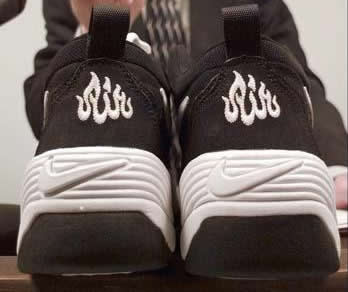
“Allah” word is visible in on Nike shoes (An incident of 2008)

undefinedNow, I don’t know about you but I think perhaps us Musilms have become too tetchy, OK so it kind of has a passing resemblance to Arabic and the central part of the design looks like lam, lam, alif, it also looks like a “W” with bits next to it. To me it resembles fire more than anything else and even has a passing resemblance to the Hindu “Om” symbol [Om wiki entry]. I emailed Nike about this and got the following reply back from their Consumer Affairs department today [20-OCT-2008]:
Dear Masud A. Khan,

Thank you for your email.

Unbeknown to Nike the script logo used on the shoe could be seen to resemble the word “Allah” written in Arabic-style script.

This is an issue we took, and still take, very seriously. Once we became aware of this situation shortly after the product went on sale in 1996, we immediately issued a recall of the product from worldwide sale and a public apology to the Islamic community.

As the product was designed and originally sold in the US, throughout this process we worked closely with the Council for American Islamic Relations (CAIR) to resolve the issue. They helped us in our efforts to rectify our mistake and to communicate our apologies to all Muslims. I attach a copy of the press release that was issued at the time outlining steps taken by Nike to rectify the issue.

We hope that you will understand that it was never out intention to offend the Islamic community, and that we have undertaken everything possible to resolve the issue and communicate our sincere apologies.

Nike has the utmost respect for all religions, cultures and individuals, and would never intentionally offend anyone. If you have any questions or further concern regarding this issue please do not hesitate to contact us.

Yours sincerely,
Leanne Fowler
Consumer Affairs Department
Nike UK Ltd


They even included a statement (first put out in 1997) that they put out after reaching an accord with CAIR in the USA as follows:

NIKE REACHES ACCORD WITH ISLAMIC GROUP – CAIR

Beaverton, Oregon, June 24, 1997 – NIKE today announced an agreement to ease Muslim concerns over the logo design on a range of summer basketball products.
“Through a long process of discussion, we have resolved our differences of opinion with the Muslim community,” said Martin Coles, NIKE’s Vice President, Europe, “While we never intended to offend, we did; we have done everything possible to communicate our sincere apologies and to address issues related to the distribution of any products offensive to the Muslim community.”
“The potential for confusion was first identified by one of our Muslim distributors,” said Coles, “We immediately affected design alterations we believed would avoid offense. Since CAIR’s alert, we have worked to mitigate the impact on the Islamic community, and have made organisational changes to ensure that similar misunderstandings are not repeated.”

The chronology of this event includes the following:

1. In late September, NIKE’s Muslim distributor in the Middle East voiced concern over the logo appearing on salesman samples of a range of summer basketball shoes — the script logo resembled the Arabic word “Allah”.

2. In addition to raising concern over this initial logo design, their distributor also suggested a number of ways to revise the logo that would (should) be acceptable to the Muslim community.

3. A design change was immediately ordered. The original logo was dropped, and the “A” was clearly separated from the “ir” on the commercial version of the product.

4. In mid-March, NIKE received a letter from the Council on American Islamic Relations (CAIR) alerting them that samples of summer basketball shoes with the original logo had been seen in the Muslim community.

5. On March 27, CAIR indicated that commercial product with the amended logo, becoming available at retail, included a graphic design that could still  “be interpreted as the Arabic word ‘Allah’” . CAIR demanded the following of NIKE:

- an apology to Muslims
-an internal investigation of how this incident occurred.
-sensitivity training on Islam for Nike employees
-the immediate recall of all shoes using either offensive symbol

6. Since that time, NIKE has taken the following steps to account for and resolve this issue:

7. NIKE has apologized to the Islamic community for any unintentional offense to their sensibilities.

8. NIKE has implemented a global recall of the original salesman samples, including an accounting of any samples which may have been sold.

9. NIKE has diverted shipments of the commercial products in question from “sensitive” markets. To date, over 30,000 pairs have been diverted from Saudi Arabia, Lebanon, Kuwait, Malaysia, Indonesia and Turkey.

10. NIKE has discontinued all models with the offending logo. No further product with either version of the logo will be produced.

11. NIKE has agreed to pull back all remaining product in their distribution center.

12. NIKE has implemented organizational changes to their design department to tighten scrutiny of logo design. Responsibility has been centralized into one department and all graphic designs must now be approved by a design review board.

13. NIKE is working with CAIR to identify Muslim design resources for future reference.

14. NIKE has taken measures to raise their internal understanding of Islamic issues. Specifically:

-Worked with CAIR to identify reference materials to locate in their Design Library
-Scheduled a discussion on Islamic imagery at their next Design Summit
-Centralize the graphic design process to ensure those with familiarity in Islamic issues evaluate all graphic designs
-Conducted a formal investigation into this issue, and CAIR is satisfied that no deliberate offense to the Islamic community was intended.

“I am glad we were able to come to a mutually acceptable understanding,” said Coles, ” I believe that we emerge from this process with a deeper understanding of Islamic sensibilities and a stronger bridge into Muslim communities.

______________________________________________________

Now, considering the initial controversy was in 1996 and was seemingly resolved a year later in 1997, why then in 2008 do we still have Musilms circulating this non-issue and then calling into question the faith of people who do not then forward the email on to an x number of other Muslims?
undefined
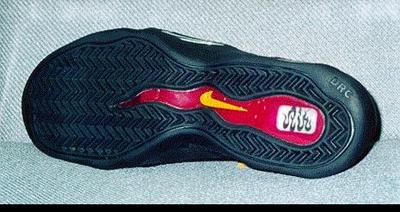
The sole of a Nike "Air" shoe.


It always boils down to the same question, whether it is something about Coke, Pepsi, Nike etc – Why would a multi-national corporation like Nike, with multi-Million dollar interests in the Middle-East and the Muslim world, purposely offend Muslims and jeopardise profits on purpose and then go to the expense of a product recall?

Come on people move on and occasionally use your brain on such matters and especially if the issue is dead, buried and, like this one, actually decomposed.

But in that case I just want to say, just visit this link of a post, It is not at all a new thing to Nike. They are continuously doing the same thing! Is it was just mistakes or anything else we don't know about it? But we Muslims are too much Conservative in this side.


Source: MasudBlog

Monday, September 19, 2011

Palestinian leader says nothing can stop UN bid

RAMALLAH, West Bank (AP) — Palestinian President Mahmoud Abbas said Monday he'll not be deterred from seeking U.N. recognition of a state of Palestine, despite what he said was "tremendous pressure" to drop the request and instead seek to resume peace talks with Israel. Abbas spoke to reporters en route to the United Nations, where he is to seek U.N. membership for "Palestine" in the West Bank, Gaza and east Jerusalem, territories Israel captured in the 1967 Mideast War. The U.S. and Israel oppose Abbas' bid, saying a state can only be established through negotiations. Abbas has said that negotiations remain his preference, but that they must be based on the pre-1967 war frontiers and a halt of all Israeli settlement construction on occupied land. Abbas said Monday that even if Israel were to agree to those two demands, "we will go to the U.N. because there is no contradiction between negotiations and going to the U.N." Officials from the Quartet of Mideast mediators — the U.S., European Union, Russia and the United Nations — have been holding talks in recent days in hopes of persuading the Palestinians to drop the U.N. bid and instead resume peace talks with Israel. 
Palestinian President Mahmoud Abbas, right, is greeted by Hanan Ashrawi, left, legislator and activist, as he arrives at his hotel in New York, Monday, Sept. 19, 2011, to attend the 66th General Assembly session of United Nations, which begins Tuesday, Sept. 20. The United States and Europe scrambled Sunday, Sept. 18, for a strategy that would help avoid a showdown over whether to admit an independent Palestine as a new United Nations member. (AP Photo/David Karp)


The Palestinian leader said he came under "tremendous pressure" in recent days, but that the proposals for a new framework for talks were unacceptable. Full U.N. membership can only be bestowed by the U.N. Security Council, where the recognition bid could be derailed if fewer than nine of the 15 members vote in favor or if the U.S. uses its veto, as it said it would. Abbas said his plan, for now, is to go to the Security Council, but suggested that he might change tactics at the last minute and go for the lesser option of General Assembly approval of Palestine as a nonmember observer state. Chances for success are much higher in the General Assembly, which Abbas is to address Friday. "From now until delivering the speech at the General Assembly, we have no thought except going to the Security Council," he said. "Then, whatever the decision is, we will sit with the leadership and decide." Asked whether he was threatened by U.S. officials trying to stop him from seeking U.N. recognition, Abbas said: "It's not a matter of threats, but they (the Americans) said that things will be very difficult after September. ... We don't know to what extent. We will know later." He said he has not been told officially that U.S. aid to the Palestinians would be cut. For months, congressional Republicans and Democrats have threatened to cut off some $500 million in economic and security assistance if the Palestinians move forward with the U.N. bid. Abbas said he's not scheduled to meet with President Barack Obama on the sidelines of the General Assembly. Concerning the possibility of mass protests in the Palestinian territories, Abbas said the only violence might come from Israeli settlers. In recent months, there has been an upswing in attacks by settlers on Palestinians and their property, some of it as retaliation for attempts by Israeli troops to remove unauthorized settler outposts. "We will never return to an intifada (uprising). We will never return to violence," Abbas said. "All our people will do is demonstrate peacefully inside the (Palestinian) cities." Abbas, however, holds no sway over the Gaza Strip or its rulers from the violently anti-Israel group Hamas, which drove out forces loyal to Abbas during a power struggle in 2007. 

Source: 
Copyright 2011 The Associated Press. All rights reserved. This material may not be published, broadcast, rewritten or redistributed.

Tuesday, July 5, 2011

Iran set to launch its own Internet


As if it weren’t enough that Iran has already figured out how to foil America’s ‘Internet in a Suitcase’ before it has even come into existence, Iranian Communications Minister Resza Taqipour has announced plans for Iran to get its own Internet by the end of August.
Monsters and Critics quoted the official Iranian News Agency, where the details were revealed, saying that Iranian Internet would be available at a speed of 8 megabits, eventually boosting it up to 20.
Of course all the speed in the world won’t help Iranians get onto some of the world’s most popular sites. Facebook and Twitter are, and will continue to be, blocked in the country, along with any opposition parties’ websites, and anything that is deemed morally or politically inappropriate.
Not only is Iran getting its own Internet, it won’t have any need for Google anymore when it gets its own search engine by 2012. The search engine will be called ‘Ya Haq,’ meaning, ‘Calling God.’
According to previous announcements by Taqipour, Iran’s Internet will be in beta testing in less than a week, in which some users will get the chance to try out the so-called Clean Web.

Source: The Next Web

Monday, March 28, 2011

Blast at Yemen explosives factory kills 78

SANAA, Yemen (AP) — A powerful blast at a factory making explosives and weapons in southern Yemen killed at least 78 people on Monday after the facility was briefly taken over by Islamic militants and then looted by residents of the area, officials said.
Many women and children from the surrounding villages were killed in the explosion, which left bodies blackened and burned, said medical and security officials in Abyan province. The blast appeared to be accidental, and one factory worker said it was caused by a looter who dropped a lit cigarette that ignited a heap of gunpowder.
The tragedy was rooted in Yemen's rapidly deteriorating security under a surge of unprecedented protests that threatens to topple the autocratic president who has ruled the impoverished and divided nation for 32 years.


On Sunday, militants took over the factory and the nearby the town of Jaar, taking advantage of the growing lawlessness in a part of Yemen that was already largely beyond the government's reach. Like several other parts of Yemen, police and security forces there had melted away in the face of the political unrest.
An anti-government protestor is lifted by others, holds his national flag and shouting slogans during a demonstration demanding the resignation of Yemeni President Ali Abdullah Saleh, in Sanaa,Yemen, Monday, March 28, 2011. Yemen's president, clinging to power despite weeks of protests, scrapped an offer to step down by year's end on Sunday, as Islamic militants taking advantage of the deteriorating security took control of another southern town. Arabic reads on the demonstrator's chest, "Leave for the sake of Yemen's future". (AP Photo/Muhammed Muheisen)

The militants are adherents of the ultraconservative Islamic movement known as Salafism. The allegiance of their particular group is bought by Yemen's government, while other Salafis agitate for the its overthrow and the establishment of Islamic rule. Nonetheless, seeing an opening to seize weaponry, the group took what they wanted and left.
They made off with two armored cars, a tank, several pickup trucks mounted with machine guns and ammunition, said 28-year-old factory worker Hakim Mohammed.
Later, dozens of locals entered the facility and looted whatever they could find, including cables, doors and vehicle fuel, Mohammed said.
The factory makes munitions, Kalashnikov assault rifles and explosives used in road construction in the mountainous area.

Some of the looters emptied large barrels of gunpowder because they wanted to use the containers for storing water, Mohammed said. A cigarette ignited what he said were massive piles of the explosive.
Among the wounded, 27 people were in critical condition, said officials at al-Razi hospital in Jaar. They spoke on condition of anonymity because they were not authorized to speak to journalists.
Chinese specialists working at the factory left several days ago because of the political turmoil and the absence of security in the area, said resident Walid Mohammed Muqbil.
Another resident, Seif Mohammed, said the blast could be heard 10 miles (15 kilometers) from the factory.
Yemen has been hit by weeks of unrest and unraveling security as protesters throughout the country demand the president's ouster and the introduction of political freedoms. A government crackdown has killed 92 protesters, according to the Shiqayiq Forum for Human Rights.
As the situation has escalated, police and security forces have withdrawn from some towns and cities in Yemen, chased out by protesters in some cases.
The area around the weapons factory was one of the places where units abandoned their posts.
The deputy governor of Abyan province, Saleh al-Samty, blamed the national government for the tragedy, saying it was a result of the lack of order resulting from the security pullback.

Copyright 2011 The Associated Press. All rights reserved. This material may not be published, broadcast, rewritten or redistributed.

Friday, March 25, 2011

Hundreds of Saudi Shi'ites protest in east

(Reuters) - Hundreds of Saudi Shi'ites staged a protest in the kingdom's oil-producing Eastern Province Friday calling for prisoner releases and a withdrawal of Saudi forces from Bahrain, activists said.

The world's No. 1 oil producer and a U.S. ally, Saudi Arabia has not seen the kind of mass uprisings that have rocked the Arab world this year. But dissent is simmering in the kingdom as unrest takes root in neighboring Yemen, Bahrain and Oman.

There were rallies in two villages close to the main Shi'ite center of Qatif shortly after midday and afternoon prayers.
"There are around 400 protesters here at the moment and some are waving Bahraini flags," said one protester who declined to be named. "The protests are peaceful and the riot police are well away from the demonstrators."
Demonstrators called for political freedoms and an end to what they call sectarian discrimination against Saudi Arabia's Shi'ite Muslim majority by the absolute Sunni monarchy.
Saudi Shi'ites have held a number of protests in Eastern Province, where most of the country's oil fields are.

A Saudi human rights group said Wednesday authorities arrested 100 protesters last week in the Shi'ite populated areas of Safwa, Qatif and its villages and Hasa.
Saudi Shi'ites complain of discrimination, saying they often struggle to get senior government jobs and benefits available to other citizens. The government of Saudi Arabia, a monarchy that usually does not tolerate public dissent, denies such charges.
Almost no Saudis in major cities answered a Facebook call for protests on March 11, in the face of a massive security presence around the country.

Dozens of Saudi men gathered outside the Interior Ministry in the capital Riyadh Sunday to demand the release of jailed relatives.
King Abdullah last week offered $93 billion in handouts and boosted his security and religious police forces but did not make concessions on political rights.
Saudi Arabia has sent 1,000 troops to Bahrain, also a Sunni monarchy, to help contain pro-democracy protests led by that Gulf Arab country's Shi'ite majority.

Source: Reuters

Tuesday, March 22, 2011

Yemeni leader says he'll step down by year's end

SANAA, Yemen (AP) — Yemen's embattled U.S.-backed president pledged to step down more than a year early but refused to immediately resign on Tuesday, infuriating tens of thousands of demonstrators demanding his ouster.
The opposition said it would not accept President Ali Abdullah Saleh's offer to resign by year's end in response to nationwide anti-government protests, which have swelled dramatically since security forces opened fatally shot more than 40 demonstrators on Friday.
"The president's statements are just another political maneuver," said chief opposition spokesman Mohammed al-Sabri. "What was acceptable yesterday is not acceptable for us today."
Anti-government protestors shout slogans and raise banners during a demonstration demanding the resignation of Yemeni President Ali Abdullah Saleh, in Sanaa, Yemen, Tuesday, March 22, 2011. Yemen's embattled U.S.-backed president said Tuesday that a military coup would lead to civil war and pledged to step down by year's end but not hand power to army commanders who have joined the opposition. (AP Photo/Muhammed Muheisen)

The standoff pushed Yemen closer to open confrontation between the two sides, fueling Western fears that Saleh's 32-year-old regime could be replaced by chaos, or a leadership less likely to cooperate with U.S. military operations against the local branch of al-Qaida.
Anger at Friday's shootings splintered Saleh's remaining support among the country's most powerful institutions, and influential clerics, tribal leaders and military commanders all began calling for his departure. Some of the country's most senior army officials declared their loyalty to the opposition on Monday.
Saleh responded with a concession, pledging in a meeting with senior officials, military commanders and tribal leaders on Monday evening that he would to step down by the end of the year. He tried to placate demonstrators by promising this month not to run again, or let his son replace him, when his term ends in September 2013.
A presidential spokesman, Ahmed al-Sufi, said Salah also pledged not to hand power to the military.
The president hardened his position on Tuesday, saying the defection of commanders including his chief military adviser, Maj. Gen. Ali Mohsen al-Ahmar, was a "mutiny and a coup against constitutional legitimacy."
"Any dissent within the military institution will negatively affect the whole nation," Saleh said in a nationally televised warning to a meeting of Yemen's Supreme Council of the Armed Forces. "The nation is far greater than the ambition of individuals who want to seize power."
Protesters massed by the tens of thousands Tuesday afternoon in the downtown Sanaa plaza they have dubbed "Taghyeer," or "Change" square. Crowds ululated, chanted and painted each other's faces in the red, white and black colors of the national flag. Conservative tribesmen bought their wives to the protest, and the women bought their children, all basking in a carnival atmosphere.
"The revolution has crossed its most difficult period," said activist Bashir al-Sid, smiling. "All that remains is the easy part."
Demonstrators began demanding Saleh's ouster more than a month ago, inspired by the wave of people power sweeping through the Middle East. His troops and loyalists have killed more than 80 demonstrators throughout Yemeni cities, according to an Associated Press tally of eyewitness, opposition and official accounts.
Al-Ahmar's defection was followed by a flurry of resignations by army commanders, ambassadors, lawmakers and provincial governors.
Al-Ahmar, commander of the army's powerful 1st Armored Division, deployed tanks and armored vehicles at the Defense Ministry, the TV building, the Central Bank and Taghyeer square, the demonstrator's epicenter.
In response, the Republican Guards, an elite force led by one of Saleh's sons, deployed troops backed by armor outside the presidential palace on the capital's southern outskirts.
Calling Al-Ahmar's defection "a turning point," Edmund J. Hull, U.S. ambassador to Yemen from 2001 to 2004, said it showed "the military overall ... no longer ties its fate to that of the president."
"I'd say he's going sooner rather than later," Hull said.
The Qatar-based Al-Jazeera network said its Yemen offices were broken into late Monday by 20 armed men who used a mechanical drill to open the door before seizing its main satellite uplink equipment, computers, TV cameras and closed-circuit surveillance cameras.
Jazeera said it had asked the Yemeni interior ministry three days ago to protect the bureau and its staff the network's journalists were threatened. The ministry did not respond, the network said.
In a sign of the Obama administration's growing alarm over the regime's crackdown on demonstrators, State Department spokesman Mark Toner called for "a cessation of all violence against demonstrators," saying Saleh should "take the necessary steps to promote a meaningful dialogue that addresses the concerns of his people."
The 65-year-old president and his government have faced down many serious challenges in the past, often forging fragile alliances with restive tribes to extend power beyond the capital. Most recently, he has battled a seven-year armed rebellion in the north, a secessionist movement in the south and an al-Qaida offshoot that is of great concern to the U.S.
Al-Qaida in the Arabian Peninsula, formed in 2009, has moved beyond regional aims and attacked the West, including sending a suicide bomber who tried to down a Detroit-bound airliner on Christmas Day with a bomb sewn into his underwear. The device failed to detonate properly.
Yemen is also home to U.S.-born radical cleric Anwar al-Awlaki, who is believed to have offered inspiration to those attacking the U.S., including Army Maj. Nidal Hasan, who is accused of killing 13 people and wounding dozens in a 2009 shootout at Fort Hood, Texas.

Copyright 2011 The Associated Press. All rights reserved. This material may not be published, broadcast, rewritten or redistributed.

Sunday, March 20, 2011

Yemeni president's own tribe demands he step down

SANAA, Yemen (AP) — Tens of thousands of people joined a funeral procession Sunday for protesters killed by government gunmen and the Yemeni president's own tribe called on him to step down, robbing the embattled U.S.-backed leader of vital support.
Yemen's ambassador to the United Nations and its human rights minister resigned to protest the crackdown, further undermining President Ali Abdullah Saleh. Experts said the president's dwindling influence was likely to either accelerate his departure or force him to resort to greater violence to retain power.
Saleh appeared to shy away from more force for the moment, disbanding police and special forces around Sanaa University, which has been the center of the deadly crackdown, and replacing them with a largely unarmed force.
Anti-government protestors pray around the bodies of the demonstrators who were killed on Friday's clashes with Yemeni security forces, during their funeral procession in Sanaa,Yemen, Sunday, March 20, 2011. The Yemeni president's own tribe has called on him to step down after a deadly crackdown on protesters, robbing the embattled U.S.-backed leader of vital support in a society dominated by blood ties. (AP Photo/Muhammed Muheisen)

"From now on, we will be controlling the entrances and exits of the square by orders from the supreme military command," said Lt. Col. Mohammed Hussein.
Friday was the bloodiest day of the monthlong uprising against Saleh, and government snipers killed more than 40 protesters. The violence drew condemnation from the U.N. and the United States, which backs his government with hundreds of millions of dollars in military aid to battle a potent al-Qaida offshoot based in Yemen's mountainous hinterlands.
Some of the country's most important religious leaders joined in the call for Saleh's resignation.
"This is definitely in my view now entering into some form of an end game," said Salman Shaikh, director of the Brookings Doha Center.
Yemen's most powerful tribe, its opposition parties and masses of young protesters have now united in calls for Saleh's departure, Shaikh said, calling that a dire sign for the president's ability to retain power.
"The disparate elements of what can be called the oppsiton have now coalesced around the demand for him to step down," Shaikh said. "This is now a very powerful, irrestible coalition."
Mohammad al-Sabri, an opposition spokesman, told The Associated Press that the opposition will under no circumstances agree to a dialogue with Saleh after the crimes his regime has committed.
"The president must understand that the only way to avoid more bloodshed and strife in this country is for him to leave. Nobody will have any regrets about him," he said.
People living in apartment buildings around the square tossed down flowers at Sunday's funeral procession. Electricity was cut off for about three hours in Yemen's major cities, and activists accused the government of trying to block people from seeing television coverage of the march. Cell service was also interrupted.
Massive crowds flooded into the Sanaa University square and solidarity demonstrations were held across the country in regions including Aden, Hadramawt, Ibb, Al-Hudaydah, Dhamar and Taiz.
"We hail with all respect and observance, the position of the people at the (Sanaa University) square," Sheik Sadiq al-Ahmar, head of Saleh's Hashed tribe, said in a joint statement with the religious leaders issued after a meeting at his home late Saturday.
Opposition parties taking part in the procession said they had have changed their position from demands for political reforms to calls for Saleh's removal.
"Our only choice now is the removal of the regime soon. We stand by the people's demand," opposition leader Yassin Said Numan told The Associated Press.
Human Rights Minister Huda al-Ban said she was stepping down to protest the government's "horrible, coward and perfidious crime." And a Foreign Ministry official told The Associated Press that UN Ambassador Abdullah Alsaidi had sent in his letter of resignation.
Health Minister Abdul-Karim Rafi told reporters the killing of protesters was "a crime unacceptable by logic or could be justified."
He said 44 protesters were killed and 192 wounded, 21 critically.
Prosecutor-General Abdullah al-Ulty said that 693 protesters were hurt and some bodies have not yet been identified.
Mohammed Naji Allaw, a lawyer and activist, said the government offering money to victims' families to not cooperate with the investigation, and was pressuring them not to participate in the funeral procession.

Copyright 2011 The Associated Press. All rights reserved. This material may not be published, broadcast, rewritten or redistributed.

Tuesday, February 15, 2011

Follow Egypt's example, Obama tells Arab world

WASHINGTON (AFP) – US President Barack Obama urged autocratic Middle Eastern allies to look to Egypt's example on Tuesday and encouraged the Iranian people to pursue their quest for democracy.
"You can't maintain power through coercion," Obama said in a stark message to Arab allies of the United States as protests raged in Algeria, Bahrain and Yemen following the ouster of presidents in Egypt and Tunisia.

"At some level, in any society, there has to be consent," Obama told a White House press conference.
Obama also condemned the crackdown in Iran, where lawmakers have demanded the hanging of opposition leaders who called the protests that left two people dead.
US President Barack Obama urged autocratic Middle Eastern allies to
look to Egypt's example on Tuesday and encouraged the Iranian people
 to pursue
 their quest for democracy (AFP/Jim Watson) 
Iranian MPs singled out Mir Hossein Mousavi and Mehdi Karroubi, who had called for protests in Tehran on Monday in support of the Arab uprisings that quickly turned into anti-government demonstrations and ended in clashes.

"People should be able to express their opinions and their grievances and seek a more responsive government," Obama said. "What's been different is the Iranian government's response which is to shoot people and beat people and arrest people.
"Real change in these societies is not going to happen because of terrorism. It's not going to happen because you go around killing innocents. It's going to happen because people come together and apply moral force to a situation," Obama said.
"We have sent a strong message to our allies in the region saying let's look at Egypt's example, as opposed to Iran's example."

Obama said that Egypt was moving in the right direction after the country's military pledged to work toward political reforms and elections, days after protests toppled longtime leader Hosni Mubarak.
"Egypt's going to require help in building democratic institutions and also in strengthening the economy that's taken a hit as a consequence of what happened," he said. "But so far at least, we're seeing the right signals coming out of Egypt."
Obama also praised the military leadership for reaffirming Egypt's international treaties, including with US ally Israel.

"Obviously there's still a lot of work to be done in Egypt itself. What we've seen so far is positive."
Political unrest, meanwhile, has spread across the Middle East.
Thousands of Bahrainis demonstrated Tuesday in the capital Manama, where two protesters died. The rally called for regime change in the Gulf kingdom like that in Egypt and Tunisia.
And in the Yemeni capital Sanaa, pro-regime supporters armed with batons and stones waded into anti-government protesters trying to march on the presidential palace, sparking clashes dispersed by police.
Obama tried to answer critics who suggest his administration was caught flat-footed by the events in Egypt, arguing that he wanted to ensure that the United States did not become the story.
"I think history will end up recording that at every juncture in the situation in Egypt that we were on the right side of history," Obama said

"What we didn't do was pretend that we could dictate the outcome in Egypt because we can't," he said. "So we were very mindful that it was important for this to remain an Egyptian event, that the United States did not become the issue."
But Obama insisted that, if anything, he was actually ahead of the curve.
"If you look at my statements, I started talking about reform two weeks or two and a half weeks before Mr. Mubarak ultimately stepped down, and at each juncture, I think we calibrated it just about right.
"I would suggest that part of the test is that what we ended up seeing was a peaceful transition, relatively little violence, and relatively little, if any, anti-American sentiment or anti-Israel sentiment or anti-Western sentiment."

Source: Yahoo! News

Journalists in the Middle East face multiple attacks

New York, February 14, 2011--As protests spread from Tunisia and Egypt to other countries in the region, journalists have been targeted by security forces, in Yemen, Iran, and Algeria, the Committee to Protect Journalists said today.

"We condemn the authorities in Yemen, Iran, and Algeria for pursuing a course of violence and intimidation to prevent media coverage of protests inspired by events in Egypt and Tunisia," said Mohamed Abdel Dayem, CPJ's Middle East and North Africa program coordinator.

A woman walks past riot police standing guard during a demonstration
in Algiers on Saturday. (Reuters/Louafi Larbi )
On Friday, Yemeni security forces assaulted an undetermined number of journalists who were covering a march in the capital, Sana'a, in solidarity with the Egyptian revolution, according to the Yemeni Journalists' Syndicate. The syndicate also reported similar attacks on journalists on Sunday during demonstrations calling for the ouster of Yemeni President Ali Abdullah Saleh. The Yemeni newspaper Al-Ghad reported that journalist Khalil al-Barh was detained by unidentified men in the kind of vehicle used by security forces for 30 minutes in Sana'a's Tahrir square. Al-Barh was released but only after security forces roughed him up and deleted footage from his camera, according to Al-Ghad.

Also on Sunday, in various locations throughout the capital, men assaulted Associated Press photographer Hani al-Ansi, Reuters photographer Khaled al-Mahdi, and Wajdi al-Salmi, a reporter for the newspaper Hadith al-Madina. The journalists had their cameras either confiscated or destroyed, local journalists told CPJ. Men in plainclothes tried to kidnap prominent journalist Samia al-Aghbry but were prevented from doing so by a group of demonstrators. Al-Aghbry was injured when she fell while trying to escape, local journalists told CPJ. She was taken to a hospital and released. Al-Jazeera reported on the air that the BBC's correspondent was attacked today as he covered ongoing demonstrations, but did not provide additional information.

The Yemeni Journalists' Syndicate submitted a complaint to the prosecutor-general, demanding an investigation into acts of violence and intimidation against journalists in recent days.

In Iran, authorities also took measures to stem reporting on demonstrations scheduled for today in some 35 cities and towns throughout the country. In addition to keeping opposition leaders under house arrest, cutting their phone lines and other forms of electronic communications, and announcing that it will deal forcefully with any demonstrators, Iranian authorities have also reduced the speed of all Internet connections inside the country to a virtual crawl in an effort to stem the flow of information, particularly photographs and videos of any potential confrontations, reformist news websites reported.

On Friday, the BBC announced that "its Persian Television service is being jammed from within Iran following coverage of the political unrest in Egypt." BBC Global News Director Peter Horrocks said that "jamming should stop immediately. The events in Egypt are being viewed by the entire world and it is wrong that our significant Iranian audience is being denied impartial news and information from BBC Persian TV."

Iranian officials announced on Sunday that a specialized media court would adjudicate what it called "media crimes" as of an unspecified date. Abbas Zagholi, a ranking official within the judiciary, is quoted by the pro-government Khabar as saying that such a court "was necessary because of special media crimes," without specifying what those entailed. Press crimes are currently adjudicated by Revolutionary Courts.

Over the past week, at least five journalists have been arrested, according to news reports. It is unclear whether these arrests are directly linked to renewed demonstrations by the opposition or if they are part of the general crackdown against journalists that has been ongoing since June 2009.

Plainclothes officers arrested Taghi Rahmani, a journalist, author, and political activist, at home on February 9, the Deutsche Welle Persian Service reported. Though no warrant was presented at the time of his arrest, conservative website Bultan News quoted a "reliable source" who said that Rahmani was involved in the "seditious" acts of 2009--a term used by the Iranian government to reference post-election protests. Security forces arrested reformist journalists and bloggers Meysam Mohammadi and Omid Mohaddes at home on the night of February 10, according to reformist news website Kaleme. No official reasons for the two arrests have been announced, according to local news websites. Journalist Maziar Khosravi was arrested at his office in the daily Sharq on February 11. Khosravi has previously worked as editor-in-chief of the reformist website Hammihan, editor-in-chief of Aftab, and foreign affairs editor of reformist newspapers Mardomsalari and Bahahr. No warrant and no reasons were given for his arrest, according to Kaleme. Freelance reformist journalist Nozhat Amirabadian was also arrested on February 11, according to the reformist news website Human Rights House of Iran (RAHANA). Amirabadian has previously worked for multiple reformist news websites such as Fararu, Hammihan, and Aftab. No warrants or reasons for arrest were presented at the time of Amirabadian's arrest, RAHANA reported.

In Algeria, security forces prevented journalists from covering anti-government protests in major Algerian cities on Saturday, according to local and international news reports. Kamel Amarni, secretary-general of the Algerian National Syndicate, told CPJ that security forces stopped and searched several journalists before confiscating their equipment. Police officers detained Bilel Zehani, a photojournalist with the Algerian agency Agence NewPress, for two hours and erased his camera's memory card, Amarni said. Internet service was shut down for several hours on Saturday and Facebook accounts deleted across the country, according to news reports.

Copyright: CPJ