Showing posts with label Iran. Show all posts

Tuesday, January 24, 2012

US launched cyber attacks on other nations

The assumption that the US has the technological know-how to cripple a competing nation has always been just that: as assumption. In a recent sit-down interview, however, a former spy chief confirmed that America has already waged cyber attacks.

Confirmed: US has already waged cyberattacks
Mike McConnell, the former director of national intelligence at the National Security Agency under George W Bush, tells Reuters this week that cyber war is more than a distant possibility. According to the current vice chairman at Booz Allen Hamilton, the US has already launched attacks on the computer networks of other nations.
McConnell did not add any input as to what countries have been hit with American cyber warfare in the past, but he did confirm that the US has already used the ability. When asked by Reuters if the United States had the capability to destroy the computer system of an adversary, McConnell responded “Yes.” When asked if it worked, he confirmed “yes” as well.

"Do we have the ability to attack, degrade or destroy? Sure. If you do that, what are the consequences? That is the question,” added McConnell.

Although the former spy chief neglected to name any countries that have been the target of American attacks, the US is believed by some to be the culprit behind a virus that targeted computer systems in Iran in 2010. Stuxnet, an advanced computer worm discovered in June of that year, impacted the computers used in conjunction with Iran’s nuclear program. In a January 2011 article in the New York Times, an American nuclear intelligence expert speaking on condition of anonymity said that the Israelis were behind Stuxnet, placing the blame on one of America’s most important allies. The expert adds in the article that Israel did indeed work hand-in-hand with the US in perfect Stuxnet before sending it to the Iranian networks, but that Washington wanted “plausible deniability.”

Other sources have since all but confirmed America’s involvement in the worm. German cyber security expert Ralph Langner told National Public Radio last year that the virus seemed like something out of science fiction, but added that, "Thinking about it for another minute, if it's not aliens, it's got to be the United States.” He went on to call the US “the leading force” behind Stuxnet, an assumption that many in Iran believe as well. While the Iranians have never officially recognized retaliation on their part, rumors of revenge via cyberwar have been rampant in recent weeks, particularly after news broke out of Mexico last month that hackers south of the border were being recruited by Iran to participate in an infiltration of American computers.

Before it launched an airstrike` attack on Libya in 2011, a cyberattack was considered as a route to oust Colonel Muammar Gaddafi, an Obama official said to the New York Times last year. In the end, however, America relied on other techniques. “These cybercapabilities are still like the Ferrari that you keep in the garage and only take out for the big race and not just for a run around town, unless nothing else can get you there,” the insider, speaking on condition of anonymity, told the Times.

Source: RT

Friday, January 13, 2012

Anti-US chants as slain Iran nuclear expert buried

TEHRAN, Iran (AP) — Thousands of mourners chanted "Death to Israel" and "Death to America" on Friday during the funeral of a slain nuclear expert whom Iranian officials accuse the two nations of killing in a bomb blast this week as part of a secret operation to stop Iran's nuclear program.
This undated photo released by Iranian Fars News Agency, claims to show Mostafa Ahmadi Roshan, who they say was killed in a bomb blast in Tehran, Iran, on Wednesday, Jan. 11, 2012, next to his son. Two assailants on a motorcycle attached a magnetic bomb to the car of an Iranian university professor working at a key nuclear facility, killing him and his driver Wednesday, reports said. The slayings suggest a widening covert effort to set back Iran's atomic program. The blast killed Mostafa Ahmadi Roshan, a chemistry expert and a director of the Natanz uranium enrichment facility in central Iran, state TV reported. (AP Photo/Fars News Agency)

The assassination of Mostafa Ahmadi Roshan has raised calls in Iran for retaliation against the U.S. and Israel, and an independent news website Friday said Iran is preparing a covert counteroffensive against the West.

Roshan, a chemistry expert and a director of the Natanz uranium enrichment facility in central Iran, was killed in a brazen daylight assassination when two assailants on a motorcycle attached a magnetic bomb to his car Wednesday in Tehran. The killing bore a strong resemblance to earlier killings of scientists working on the Iranian nuclear program.

State TV showed thousands of people carrying Roshan's coffin through central Tehran before it was taken to a north cemetery for burial. As it marched, the crowd chanted "death to terrorists."

Iran's Supreme Leader Ayatollah Ali Khamenei, who has the final say on all state matters, called Roshan's killing a "cowardly assassination" and accused the U.S. and Israel of being behind the attack. He vowed Thursday that the perpetrators and those who ordered the attack would be punished.

U.N. Secretary Ban Ki-moon on Friday during a visit to Lebanon issued a vague condemnation of the killing, saying attacks on "any people, whether scientist or civilian," are not acceptable, according to U.N. spokesman Eduardo del Buey.

U.S. Secretary of State Hillary Rodham Clinton has denied any American role in the slaying and the U.S administration condemned the attack. Israeli officials, in contrast, have hinted at covert campaigns against Iran without directly admitting involvement.

The assassination was carried out a day after Israeli military chief Lt. Gen. Benny Gantz was quoted as telling a parliamentary panel that 2012 would be a "critical year" for Iran — in part because of "things that happen to it unnaturally."

That prompted Hossein Shariatmadari, director of the hardline Iranian daily newspaper Kayhan, to ask why Iran did not avenge Roshan by striking Israel.

The independent news website, irannuc.ir, quoted an unidentified security official as saying Iran is preparing a covert counteroffensive against the West in retaliation for the bomb blast. It suggested the retaliation could include assassinations abroad.

"Iran's intelligence community is in a very good position to design tit-for-tat operations to retaliate for assassinations carried out by Western intelligence services," the official said, according to the website. "Iran's response will be extraterritorial and extra-regional. It follows the strategy that none of those who ordered or carried out (the attacks) should feel secure in any part of the world."

The website's report was also carried by the semiofficial Fars news agency, which is close to the elite Revolutionary Guard.

Source: The Associated Press

Thursday, January 5, 2012

Thousands of US troops deploying to Israel

Without much media attention, thousands of American troops are being deployed to Israel, and Iranian officials believe that this is the latest and most blatant warning that the US will soon be attacking Tehran.
Reuters / Nir Elias
Reuters / Nir Elias
Tensions between nations have been high in recent months and have only worsened in the weeks since early December when Iran hijacked and recovered an American drone aircraft. Many have speculated that a back-and-forth between the two countries will soon escalate Iran and the US into an all-out war, and that event might occur sooner than thought.

Under the Austere Challenge 12 drill scheduled for an undisclosed time during the next few weeks, the Israeli military will together with America host the largest-ever joint missile drill by the two countries. Following the installation of American troops near Iran’s neighboring Strait of Hormuz and the reinforcing of nearby nations with US weapons, Tehran authorities are considering this not a test but the start of something much bigger.

In the testing, America's Theater High Altitude Area Defense, or THAAD, missile system will be operating alongside its ship-based Aegis system and Israel's own program to work with Arrow, Patriot and Iron Drone missiles.

Israeli military officials say that the testing was planned before recent episodes involving the US and Iran. Of concern, however, is how the drill will require the deployment of thousands of American troops into Israel. The Jerusalem Post quotes US Commander Lt.-Gen Frank Gorenc as saying the drill is not just an “exercise” but also a “deployment” that will involve “several thousand American soldiers” heading to Israel. Additionally, new command posts will be established by American forces in Israel and that country’s own IDF army will begin working from a base in Germany.

In September, the US European Command established a radar system in Israel.

With America previously equipping Saudi Arabia and the United Arab Emirates with weaponry to wreck any chance of an Iranian nuclear weapon program from close by, the US will now have added forces on the ready in Israel and Germany under what Tehran fears is a guise being merely perpetrated as a test-run. RT reported last week that the US is equipping Saudi Arabia with nearly $30 billion F-15 war planes, a deal that comes shortly after Washington worked out a contract with Dubai to give the UAE advanced “bunker buster” bombs that could decimate underground nuclear operations in neighboring Iran.

Since the US surveillance mission over Iran that left overseas intelligence with a captured American drone aircraft, tensions have only escalated between the two nations. After Iran threatened to close down the Strait of Hormuz, a crucial path for the nation’s oil trade, the US dispatched 15,000 marines into the area.

Source: RT

Tuesday, January 3, 2012

Iran warns U.S. over aircraft carrier

Iran warned the United States Tuesday not to return a U.S. aircraft carrier "to the Persian Gulf region."

"The Islamic Republic of Iran will not repeat its warning," said Maj. Gen. Ataollah Salehi, commander of Iran's Army, according to the state-run news agency IRNA.

Salehi "said the country will not adopt any irrational move but it is ready to severely react against any threat," the report added.
The aircraft carrier USS John C. Stennis is in the Persian Gulf region.
The commander spoke at the Port of Chabahar in southern Iran, as forces held a military parade the day after Iran ended naval drills in the region, IRNA reported.

What's Iran's real plan? U.S. sanctions hurting Iran's currencyReport: Iran tests nuclear fuel rodNavy won't tolerate Iran 'disruption'

Iran was referring to the USS John C. Stennis, part of the U.S. Navy's fleet in the region. It moved last week from the Persian Gulf into the North Arabian Sea, as part of what the Navy's 5th Fleet called a pre-planned transit.

Iran said the ship's movement during Iran's naval exercises showed that the United States "understood" that Iran's maneuvers were not "suicidal or aggressive," but rather about Iran protecting its own "interests and power."

But Western diplomats last week described the naval drills -- which, according to Iranian officials, included test-firing missiles -- as further evidence of Iran's volatile behavior.

Iran's naval exercises began in the strait and also included waters in the Sea of Oman and the Indian Ocean up to the Gulf of Aden, according to IRNA.

After Tuesday's warning from Iran, a Pentagon spokesman issued a statement saying "deployment of U.S. military assets in the Persian Gulf region will continue as it has for decades."

"These carrier strike group deployments are necessary to maintain the continuity and operational support to ongoing missions in the U.S. Central Command area of responsibility," George Little said.

The United States has had forces in the Persian Gulf since World War II. Its ships sail through the Persian Gulf frequently, many on their way to and from the 5th Fleet's headquarters in Bahrain. Its area of responsibility covers about 2.5 million square miles, including the Persian Gulf, which the Navy also refers to as the Arabian Gulf; the Red Sea; the Gulf of Oman and parts of the Indian Ocean.

The dispute over the Stennis began last week. Tehran said an Iranian warplane identified a U.S. carrier patrolling the area of the drills. State-run media showed a picture of the vessel.

Iran's state-run Press TV said Tuesday the images it showed last week were of the Stennis.

Tuesday's events came amid growing tensions over the Strait of Hormuz, a critical shipping channel.

Iran last week threatened to block the strait if sanctions are imposed on its oil exports. France, Britain and Germany have proposed sanctions to punish Iran's lack of cooperation on its nuclear program.

Cmdr. Amy Derrick Frost, spokeswoman for the U.S. Navy's 5th Fleet in Bahrain, responded at the time, "Anyone who threatens to disrupt freedom of navigation in an international strait is clearly outside the community of nations; any disruption will not be tolerated."

In his statement Tuesday, Pentagon spokesman Little said the Navy "operates under international maritime conventions to maintain a constant state of high vigilance in order to ensure the continued, safe flow of maritime traffic in waterways critical to global commerce.

"Our transits of the Strait of Hormuz continue to be in compliance with international law, which guarantees our vessels the right of transit passage. We are committed to protecting maritime freedoms that are the basis for global prosperity; this is one of the main reasons our military forces operate in the region."

The dispute has been pushing up oil prices. Nearly 17 million barrels of oil a day pass through the strait, according to the U.S. Energy Information Agency. "Flows through the Strait in 2011 were roughly 35% of all seaborne traded oil, or almost 20% of oil traded worldwide," the agency says.

But closing the strait would require means that likely are not available to Iran, said Jean-Paul Rodrigue, an expert in transport geography at Hofstra University. "At best, Iran can posture and potentially disrupt traffic for a short duration," he said.

China and Japan are more dependent on Persian Gulf oil than the United States is, he said, and he added that any move to close the strait would be "suicidal" to the current regime.

Source: CNN

Thursday, December 22, 2011

US military 'ready to engage in a conflict with Iran'

America's most senior military official has indicated that the country is ready to engage in a conflict with Iran, if President Barack Obama were to give the signal.


Tensions have been growing in the region following international condemnation over Tehran's growing nuclear ambitions.
Last month, Britain's ambassador to Iran was expelled from the country following attacks on the British Embassy. The US is also involved in a standoff over a downed spy drone, which President Mahmoud Ahmadinejad has refused to return despite America's requests.
Iran's President Mahmoud Ahmadinejad and President Barack Obama Photo: Reuters/EPA

General Martin Dempsey, chairman of the US joint chiefs of staff, said that the US military had reached a point where they were ready to execute force against Iran if necessary.
In an interview with US media in Afghanistan he said: "We are examining a range of options. I'm satisfied that the options that we are developing are evolving to a point that they would be executable if necessary."
His comments come just days after Leon Panetta, US secretary of defence, said "no options were off the table" in stopping Iran develop a nuclear weapon.

Gen Dempsey said he had been quietly leading behind the scenes preparations for an attack against Tehran but said a war with the nation would be a "tragedy".
"My biggest worry is that it may miscalculate our resolve. Any miscalculation could mean that we are drawn into conflict and that would be a tragedy for the region and the world," he said.
Asked whether the US military is collecting information on the Middle Eastern nation via spy drones, Gen Dempsey said it would be "imprudent" for them not to attempt to find out what they were doing but stopped short of saying they had used unmanned aircraft.
"If you are asking are we gathering intelligence against Iran in a variety of means, the answer is of course," he said. "It would be imprudent of us not to understand what a nation which has declared itself an adversary of the United States is doing."

Gen Dempsey said the US is collaborating with Israel in its intelligence gathering but reiterated that there are no guarantees the Israelis would inform the US before launching an attack.
"We are trying to establish some confidence on the part of the Israelis that we recognise their concerns and are collaborating with them on addressing them," he said.
Leon Panetta, the secretary of defence, said this week that the US was prepared to step in to prevent Tehran realising its nuclear ambitions. He estimated that the country was only a year away from reaching its goal.

"The United States does not want Iran to develop a nuclear weapon," he said. "That is a red line for us and that is a red line for the Israelis. If we have to do it we will do it. If they proceed and we get intelligence that they are proceeding in developing a nuclear weapon then we will take whatever steps necessary to stop them. There are no options that are off the table."
If Iran were to gain a nuclear weapon, it could trigger a nuclear arms race in the Middle East with officials in Saudi Arabia already saying they will look towards developing nuclear capabilities if the Iranians arm themselves.

Further evidence of US reconnaissance missions in the region include the indictment of several alleged CIA spies.
In May this year, Iran's intelligence ministry announced the arrest of 30 CIA "spies" it claimed were conducting sabotage missions.
Another 15 alleged US-Israeli spies were indicted earlier this month and this week Iranian state television showed clips of ex-US Marine Amir Hekmati allegedly confessing to espionage.
Earlier this month, the EU agreed to impose new sanctions against 180 officials in Tehran in an attempt to curtail the nation's nuclear programme. EU foreign ministers also said they were looking at additional measures to impose on Tehran's energy sector.

Source: Telegraph

Sunday, December 4, 2011

China will not hesitate to protect Iran even with a third World War

On November 21st, America, UK and Canada announced more sanctions against Iran. France also proposed to adopt new sanctions to force Tehran to stop it's nuclear project. On Nov 23rd, the spokesman of Chinese Communist Party (CCP)'s Foreign Ministry said in a regular press conference held in Beijing that China is opposed to unilateral sanctions against Iran.


Scholars believe that, being isolated, China and Iran need mutual support. Meanwhile, the CCP government, with internal and external difficulties, may express an even tougher diplomatic "voice".

"Reuters" reported on Nov 23rd: "The United States, UK and Canada have announced new sanctions against Iran in the areas of energy and finance. France proposed 

'unprecedented' new sanctions, including freezing the assets of the Central Bank of Iran and suspending the purchase of Iran's oil.

Earlier, the "International Atomic Energy Agency" (IAEA) ad issued a report that Iran may be secretly developing nuclear weapons.

On Nov 23rd, the CCP's Foreign Ministry expressed opposition to the imposition of unilateral sanctions against Iran.

In this regard, Xia Ming, a political professor from "City University of New York" in America, believes that since the Cold War, the United States and Western 

society's biggest challenges have been seen as being from China and Iran. They are both isolated by the United States and the West. Therefore, China's policy is foreseeable.

Xia Ming says: "China and Iran are facing strong Western challenges within politics, economy and culture. So these two countries basically have a kind of coordinatio 

on the international stage, to support each other. So we can see that China and Iran coordinate a lot, with a lot of cooperation in matters of energy, arms and so on."

"Associated Press" also reported on Nov 23rd: "Since 2006, the United Nations have carried out 4 rounds of sanctions against Iran. But with export of energy, Iran has not been severely affected by the sanctions."

"AFP" said: "China supports Iran and purchases large quantities of oil from Iran. Meanwhile, China is Iran's biggest trading partner. Their bilateral trade totals up to $ 30 billion.

"Voice of America" reported, according to Chinese customs' data, this year (2011) Iran could become China's second largest crude oil supplier.

However, Iran disdains the new round of sanctions. Israel and Washington said in the event that other efforts were not effective, the possibility of military action would not be ruled out.

It's puzzling to some that Major General Zhang Zhaozhong, a professor from the Chinese National Defense University, said China will not hesitate to protect Iran even with a third World War.

Professor Xia Ming: "Zhang Zhaozhong said that not hesitating to fight a third world war would be entirely for domestic political needs. To some extent though, this would be completely ridiculous to encourage"

Professor Xia Ming pointed out that the United States and Western societies may deal with Iran by a method of "Jasmine Revolution", similar to what happened in Libya. From the perspective of the Libya model, NATO could not possibly involve itself in large-scale military action, and it would be impossible to start a new war.

In fact, a senior European diplomat with anonymity in Tehran said that the Iranian government was actually very worried about a military strike. Analysts also say that ordinary people don't worship their leaders so much any more.

But Professor Xia Ming said that the CCP regime itself is facing a much bigger crisis than Iran. The CCP regime not only faces challenges from Southeast Asia, the South China Sea, South Asia countries and so on, but also faces the pressure from America for the RMB exchange rate, export, and human rights issues, as well as the pressure of domestic issues meanwhile.

Professor Xia Ming says : "China is facing pressure from America. Meanwhile, current domestic pressure is also very considerable. In particular, we can see in civil society, the challenge to the Chinese government and resistance forces are growing. Therefore, the Chinese government is indeed facing the arrival of a big power shift in the 18th session. So, China may express a tougher diplomatic voice. On the one hand, it is a reaction to pressure from America. On the other hand, it needs to meet the demand of domestic nationalist groups.

Russia is another ally of Iran, with similar policy to that of China. Toward Iran.

Source: YouTube

Wednesday, November 30, 2011

Britain orders Iran's diplomats to leave UK

LONDON (AP) — Britain ordered Iran on Wednesday to remove all its diplomats from the U.K. within 48 hours following attacks on its embassy and a residential compound in Tehran — one of the most significant diplomatic retaliations against Iran since the 1979 U.S. embassy crisis.
Iranian protesters break the windows of a British Embassy building, in Tehran, Iran, Tuesday, Nov. 29, 2011. Dozens of hard-line Iranian students stormed the British Embassy in Tehran on Tuesday, bringing down the Union Jack flag and throwing documents from windows in scenes reminiscent of the anger against Western powers after the 1979 Islamic Revolution. The mob moved into the diplomatic compound two days after Iran's parliament approved a bill that reduces diplomatic relations with Britain following London's support of recently upgraded Western sanctions on Tehran over its disputed nuclear program. (AP Photo/Vahid Salemi)

Foreign Secretary William Hague told the House of Commons that Britain had also withdrawn its entire diplomatic staff from Iran after angry mobs hauled down Union Jack flags, torched a vehicle and tossed looted documents through windows.

The rare move to kick out a country's entire diplomatic corps marks a significant souring of ties between Iran and the West, amid deepening suspicions over Tehran's pursuit of nuclear weapons. Tensions were heightened in October when U.S. officials accused agents linked to Iran's Quds Force — an elite wing of the powerful Revolutionary Guard — of a role in an alleged plot to kill the Saudi ambassador to the U.S.

Germany, France and the Netherlands all recalled their ambassadors from Iran late Wednesday for consultations on further action in response. Norway closed its embassy in Tehran as a precaution.

For many, the hours-long assault Tuesday on the British embassy in Tehran was reminiscent of the chaotic seizure of the U.S. embassy there in 1979. Protesters replaced the British flag with a banner in the name of a 7th-century Shiite saint, Imam Hussein, and one looter showed off a picture of Queen Elizabeth II apparently taken off a wall.

"The idea that the Iranian authorities could not have protected our embassy or that this assault could have taken place without some degree of regime consent is fanciful," Hague told lawmakers.

Iran currently has 18 diplomats in Britain, according to Britain's foreign ministry.

Britain previously ordered Iran to remove its diplomats in 1989, when the two nations broke off ties over a fatwa, or religious edict, ordering Muslims to kill British author Salman Rushdie because his novel "The Satanic Verses" allegedly insulted Islam.

The White House strongly condemned the attacks and European Union foreign ministers were meeting Thursday to consider possible new sanctions. Hague also praised Poland, Russia, China and the UAE for offering support and expressing their concern.

The French foreign ministry said it was moved to act "in the face of this flagrant and unacceptable violation of the Vienna Convention on diplomatic relations and the gravity of the violence."

Italy's foreign minister Giulio Terzi said Rome was also evaluating whether to keep its diplomatic presence in Iran.

Austrian Foreign Minister Michael Spindelegger said Iran was placing itself "outside of the framework of international law," Hague said.

France's budget minister, Valerie Pecresse, said the EU should consider a total embargo on oil exports, or a freeze on Iranian central bank holdings. British officials said the U.K. would likely support new measures against Iran's energy sector.

Hague claimed those involved in Tuesday's attack were members of a student group allied with the Iranian Revolutionary Guard's paramilitary Basij organization, which recruits heavily on university campuses.

"We should be clear from the outset that this is an organization controlled by elements of the Iranian regime," he said.

Hague told Parliament the private quarters of staff and Britain's ambassador were trashed in the attack and that diplomats' personal possessions were stolen.

"This is a breach of international responsibilities of which any nation should be ashamed," he said.

Some were alarmed by Hague's tough tone. David Miliband, Britain's former foreign secretary, said he hoped the robust words would not become "part of the very unwelcome drumbeat of war."

About 24 British embassy staff and dependents were based in Tehran. They are all adults because Britain will not post diplomats with small children to Iran for security reasons.

Iran's government has expressed regret about the "unacceptable behavior" of protesters, whose attacks began after anti-British demonstrations apparently authorized by authorities.

But Iran's Parliament Speaker Ali Larijani said the "wrath of (students) resulted from several decades of domination-seeking behavior of Britain."

Iran's tensions with Britain date back to the 19th century, when the Persian monarchy gave huge industrial concessions to London, which later included significant control over Iran's oil industry. In 1953, Britain and the U.S. helped organize a coup that overthrew a nationalist prime minister and restored the pro-Western shah to power.

More recently, Iran was angered by Britain's decision to honor Rushdie with a knighthood in 2007, and over its involvement in Western scrutiny of Iran's nuclear program.

In March 2007, Iran detained 15 British sailors and marines for allegedly entering the country's territorial waters in the Gulf — a claim Britain denies. The 15 were released after nearly two weeks in captivity.

On Sunday, Iran's parliament approved a bill to downgrade relations with Britain, vowing to expel the country's ambassador.

Source: The Associated Press

Saturday, November 12, 2011

Accidental blast at Iranian arms depot kills 15

TEHRAN, Iran (AP) — An accidental explosion at a Revolutionary Guard ammunition depot west of Tehran killed at least 15 soldiers on Saturday, officials said.
In this image taken from amateur video smokes rises from an accidental explosion at a Revolutionary Guard ammunition depot outside Bidganeh village,west of Tehran which killed at least 15 people on Saturday Nov. 12, 2001, officials said. The explosions occurred when military personnel were transporting munitions at a base, said Guard spokesman Ramazan Sharif. The base is located outside Bidganeh village, 25 miles (40 kilometers) southwest of the capital. (AP Photo) TV OUT

The explosion occurred while military personnel were transporting munitions at a base, said Guard spokesman Gen. Ramazan Sharif. The base is located outside Bidganeh village, 25 miles (40 kilometers) southwest of the capital.

The Guard is Iran's most powerful military force.

"My colleagues at the Guard were transporting ammunition at one of the depots at the site when an explosion occurred as a result of an accident," Sharif said.

At least 15 Guard members were killed, state TV reported. The semi-official ISNA news agency said 10 people were injured and hospitalized. Sharif said some of them were in critical condition.

Lawmaker Parviz Soroori ruled out sabotage.

"No sabotage was involved in this incident. It has nothing to do with politics," Soroori was quoted as saying by the parliament's website, icana.ir.

Source: The Associate Press

Monday, October 10, 2011

World Day Against the Death Penalty: Too many Troy Davises

People around the world and in Taiwan will be celebrating the 9th World Day against the Death Penalty on 10 October by calling on governments still using the death penalty to stop executions and join the global trend toward abolition.

Some people will be carrying on the fight in the name of Troy Davis who, in spite of worldwide campaigns and support, was executed in the United States on 21 September 2011. In a conversation with Amnesty International shortly before his death, he reminded us “the struggle for justice doesn’t end with me. This struggle is for all the Troy Davises who came before me and all the ones who will come after me.”
Taiwanese people protest the death penalty
Taiwan's resumption of executions runs counter to the 
global trend ©Amnesty International

Taiwan’s Chiou Ho-shun may be one of these Troy Davises. Like Troy, he has spent more than 20 years on death row. Like Troy, there is also doubt in the case against him.

Troy Davis was sentenced to death in 1991 for the murder of off-duty police officer Mark Allen MacPhail in Savannah, Georgia. The case against him primarily rested on witness testimony. Since his 1991 trial, seven of key nine witnesses recanted or changed their testimony, some alleging police coercion.

Chiou Ho-shun may not have the public profile of Troy Davis but his case is no less significant.  He and his co-defendants say that they were held incommunicado for the first four months of their detention and they were tortured to make them confess to the kidnapping and killing of Lu Cheng and the murder of Ko Hung Yu-Lan. They later retracted their confessions.

In 1994, after an official investigation, two public prosecutors and 10 police officers handling the case were convicted of extracting confessions through torture.

The death penalty is irrevocable. Taiwan knows this all too well. In February this year President Ma Ying-jeou apologized for the execution of an innocent man in 1997, former air force private Chiang Kuo-ching.

More countries realize every year that the only way to ensure mistakes like this are not made is to abolish the penalty. 139 countries have abolished the death penalty in law or in practice. Of the remaining 58 retentionist countries, only 23 executed in 2010.

In 2010 more states than ever before voted at the UN in favour of a worldwide moratorium on executions. And in 2011, in the United States, Illinois became the 16th state to abolish the death penalty.

In Taiwan the four executions in 2010 and the five in 2011, stand in stark, disturbing contrast to the rising tide of world opinion in favour of abolition.

Countries that insist on using the death penalty continue to claim that they use it only in accordance with international law. But most of their actions blatantly contradict these claims.

It is often imposed after unfair trials and based on confessions extracted through torture. It is often used against political opponents, poor people, and other marginalized groups. It is sometimes even used against people who allegedly committed crimes when they were under 18 or who have significant mental impairments.

Worryingly, death sentences are handed down for acts such as fraud, sorcery, apostasy, drug-related offences or sexual relations between consenting adults, which fall far short of the legal threshold of ‘most serious’ crimes. In just the last year, death sentences were imposed for drug-related offences in China, Iran, Indonesia, Malaysia, Singapore and Yemen.

Taiwan also acts contrary to international law as it provides no procedure that would allow people under sentence of death to seek pardon or commutation of the sentence – a right recognized by International Covenant on Civil and Political Rights, which Taiwan has legally committed to implement.

Taiwan was once considered a leader in the move to abolish the death penalty in Asia, but the recent executions are a step backwards. If Taiwan is really committed to ending executions, it should start by commuting the death sentences of all people currently threatened with execution.

The struggle for abolition does continue, in the name of Troy Davis, in the name of Chiang Kuo-ching and in the name of Chiou Ho-Shun and all others facing execution around the world.

Source: Amnesty International

Tuesday, July 5, 2011

Iran set to launch its own Internet


As if it weren’t enough that Iran has already figured out how to foil America’s ‘Internet in a Suitcase’ before it has even come into existence, Iranian Communications Minister Resza Taqipour has announced plans for Iran to get its own Internet by the end of August.
Monsters and Critics quoted the official Iranian News Agency, where the details were revealed, saying that Iranian Internet would be available at a speed of 8 megabits, eventually boosting it up to 20.
Of course all the speed in the world won’t help Iranians get onto some of the world’s most popular sites. Facebook and Twitter are, and will continue to be, blocked in the country, along with any opposition parties’ websites, and anything that is deemed morally or politically inappropriate.
Not only is Iran getting its own Internet, it won’t have any need for Google anymore when it gets its own search engine by 2012. The search engine will be called ‘Ya Haq,’ meaning, ‘Calling God.’
According to previous announcements by Taqipour, Iran’s Internet will be in beta testing in less than a week, in which some users will get the chance to try out the so-called Clean Web.

Source: The Next Web

Sunday, February 20, 2011

Ex-President Rafsanjani daughter arrested in Iran

Iran has arrested the daughter of reformist ex-President Akbar Hashemi Rafsanjani for taking part in a banned protest march, state media reports say.

Faezeh Hashemi Rafsanjani was held in Tehran while "making blunt statements and chanting provocative slogans", said the official news agency Irna.
Faezeh Hashemi Rafsanjani - file image from 2009
Faezeh Hashemi Rafsanjani has a long history
of arrests and court appearances
She has been held several times before for opposition-related activity.
Iran has seen a number of opposition protests since the wave of unrest began in north Africa earlier in the year.
Iran's opposition Green movement had called for a day of demonstrations for Sunday.
Activists reported that groups of protesters had managed to gather in a number of places in Tehran, including outside the headquarters of Iran's state broadcaster.

But Iran's authorities appear to be determined to make sure that any protests are contained and stopped, says the BBC's Tehran correspondent James Reynolds, reporting from London.
Some journalists had been warned by the government not to go out into the streets to cover any unrest.
In some places access to websites has been blocked. Reports say that police wearing anti-riot gear have been deployed in the centre of Tehran.
Last Monday thousands of opposition members rallied for the first time in more than a year. Two people were killed during the protests.
Further clashes broke out on Wednesday during the funeral of one of the people killed on Monday.

Source: BBC

Iran anti-govt demos under way

Several Iran opposition websites said that anti-government demonstrations had started in parts of Tehran on Sunday, as police said large numbers of security forces were deployed in the capital.
"Police fired tear gas as a cat-and-mouse game (between police and demonstrators) began in Vali Asr Square,'' the Rahesabz.net said citing witnesses.
Crowds of demonstrators were also gathering in other squares and some streets, shouting "Allahu Akar'' (God is Greatest), the Sahamnews.org website of opposition leader Mehdi Karroubi, said.

No demonstrations were reported by Iran's broadcast media or news agencies, while foreign media have been banned from covering any opposition gatherings.
Tehran traffic police chief Hossein Rahimi confirmed to the state news agency IRNA that security forces were deployed in the capital.
"Traffic was heavy in some roads due to the presence of police and special forces,'' Rahimi said, but added that no part of Tehran was blocked and no traffic restrictions were imposed.
"The traffic was flowing,'' he said.
The demonstrations were called by a group owing allegience to opposition leaders Karroubi and Mir Hossein Mousavi.

The group, Council for Coordination of Green Movement Hope, posted the call for gatherings on Sunday on several opposition websites to mark the seventh day after the killing of two people in protests in Tehran on Monday.
Those protests, which saw demonstrators clash with security forces, were the first since Feburary last year when the authorities marked the 31st anniversary of the Islamic revolution.
Nine security personnel were injured, officials and websites said.
Anti-government protests erupted in Iran after a June 2009 presidential election, in which Mousavi and Karroubi, both candidates, charged that the incumbent Mahmoud Ahmadinejad was fraudulently re-elected.

Source: AFP

Tuesday, February 15, 2011

Clinton Says It's Time For Iran To 'Open Up'


U.S. Secretary of State Hillary Clinton has hailed the "courage" and "aspirations" of antigovernment protesters in Iran, after thousands of them took to the streets of several Iranian cities.
In Tehran, opposition supporters rallying in solidarity with uprisings in Egypt and Tunisia clashed with security forces. One death was reported and dozens of people detained.
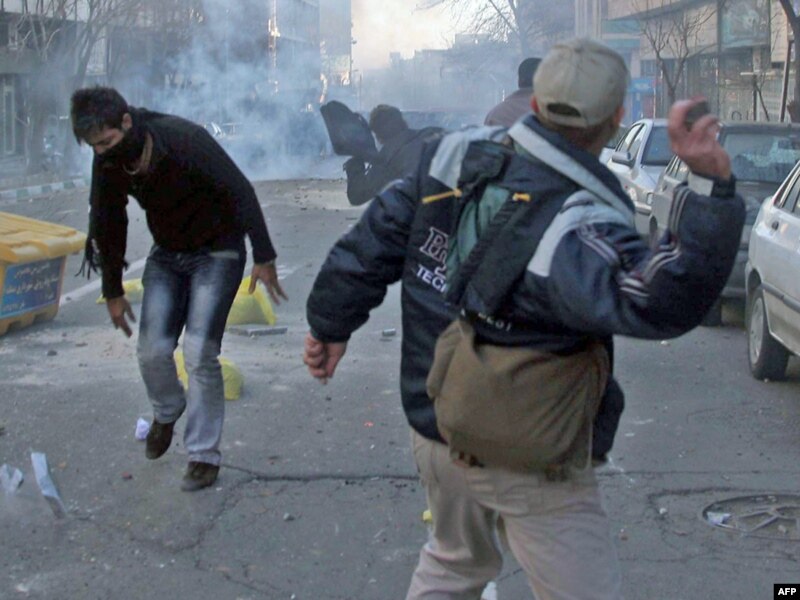
Protesters throw stones at riot police during an antigovernment 
demonstration in Tehran on February 14.
Speaking to reporters during a visit to Congress, Clinton wished the opposition and “the brave people in the streets across cities in Iran the same opportunity that they saw their Egyptian counterparts seize in the last week."
She also pressed Tehran to follow Egypt's example and "open up" its political system.

"We support the universal human rights of the Iranian people," she said. "They deserve to have the same rights that they saw being played out in Egypt and that are part of their own birthright."

U.S. Secretary Hillary Clinton: "Talk about a revolution that was hijacked; Iran is Exhibit A."

Eyewitnesses told RFE/RL that thousands of protesters on February 14 answered calls from the opposition to turn out for a banned rally in Tehran in support of the recent uprisings that ousted long-serving rulers in Tunisia and Egypt.

Protests were also reported in several other cities, including Shiraz and Isfahan.

Tehran demonstrators chanting slogans against Iran's Supreme Leader Ayatollah Ali Khamenei were met with opposition by security forces, who fired into the air and used tear gas to disperse the crowd in the streets leading to Azadi Square -- the announced site of the main rally.

Opposition websites reported "dozens" of arrests at the rally -- the most significant since the December 2009 street protests that shook the Islamic republic and in which eight people were reported killed.

The hard-line Fars news agency quoted Iran’s deputy police chief as saying one person was killed and a number of other people were wounded, including nine security force members, in shootings.

Blaming the outlawed Mujahedin Khalq (MEK) group for the shootings, Ahmad Reza Radan said the gatherings were directed by the United States, Britain, and Israel.

undefined
Members of the Iranian parliament shout slogans calling for the execution of opposition leaders in Tehran on February 15.

While Iran backed the Arab uprisings in Tunisia and Egypt, authorities banned the February 14 rally planned by opposition leaders Mir Hossein Musavi and Mehdi Karrubi.

Ahead of the protest, Musavi and Karrubi were reportedly prevented from leaving their houses. Karrubi was put under house arrest last week, while on February 14 Musavi and his wife, Zahra Rahnavard, were prevented by security forces from joining the demonstration.

Their telephone lines were reportedly cut to prevent them from communicating with opposition members.

Today, state news agency IRNA reported that lawmakers called for the execution of Musavi , Karrubi, and former President Mohammad Khatami, who has aligned himself with the opposition.

Parliament speaker Ali Larijani said the opposition leaders had been "misled" by Iran's arch foes and called for a committee to be formed to probe and "confront" the opposition movement.

Washington has noted the inconsistency in Iran's position on the Egyptian uprising -- praising Egyptian protesters on the one hand while clamping down on dissent at home.

Clinton elaborated on that point in a February 14 interview with Michel Ghandour of Alhurra television.

“Well, I find it very ironic that Iran is trying to give lessons in democracy to anybody," she said. "Talk about a revolution that was hijacked -- Iran is Exhibit A. What Iran is doing to its people, even as we speak, where there are protesters trying to have their voices heard in Iran who are being brutally suppressed by the Iranian security forces, I don’t think anyone in the Middle East – or frankly, anyone in the world – would look to Iran as an example for them.”

Britain's Foreign Secretary William Hague made a similar comment on February 14, saying the Iranian people had the right to express their views about their country – just like the Egyptians.

On a visit to Iran, Turkish President Abdullah Gul warned that "when leaders and heads of countries do not pay attention to the demands of their nations, the people themselves take action to achieve their demands."