Showing posts with label ANALYSIS. Show all posts

Friday, February 3, 2012

Analysis: A sobering look at Facebook

(Reuters) - It's the year's hottest initial public offering, but some wealth managers find themselves having a hard time recommending Facebook to their clients.
An employee works on a computer at the new headquarters of Facebook in Menlo Park, California January 11, 2012.   REUTERS-Robert Galbraith
The world's biggest social network is expected to seek a $75 billion to $100 billion valuation in its IPO, the most anticipated stock offering from Silicon Valley since Google Inc went public in 2004.

At Granite Investment Advisors in New Hampshire, Chief Investment Officer Scott Schermerhorn has already been fielding queries from clients eager to get in on the action.

"We had some clients call and once we step them through the numbers, they sober up," he said. "The valuation is 100 times earnings in a stock market that is trading at 12."

"At the end of the day, if you have a small amount of money that you are in a position to lose a chunk of it and you want to speculate on Facebook, go ahead," he added. "But don't use money that you really need to save to do it. I would put it in Microsoft, which is dirt cheap right now."

To be sure, most technology analysts would argue that Facebook's growth potential far exceeds that of Microsoft Corp, whose stock has largely traded between $20 and $30 in the past decade. It is taking its first steps toward content streaming for instance, and has yet to make a serious overseas thrust.

And a $100 billion valuation for Facebook at the top end - while huge in absolute terms - is not that out of whack in Silicon Valley IPO tradition. Facebook is seeking a multiple of up to 27 times annual revenue, or up to 100 times earnings.

Apple Inc - today, the world's most valuable technology corporation - went public at a valuation of just $1.19 billion in 1980, equivalent to 25 times revenue and 102 times earnings. Google - to which Facebook is most often measured against in terms of potential - was valued at $23 billion at the time of its 2004 debut, or 218 times earnings.

But the sheer size of Facebook's valuation means that it will have to become the world's first $700 billion company if it is to replicate the gain in Google's stock.

"At these valuations, investors really need to set aside emotion...and invest with their heads," said Edward Reinhart, managing partner at Capital Advisors Wealth Management, who owns Facebook shares bought on private markets two years ago.

Reinhart, who advises clients on retirement planning, warned that hype building up ahead of Facebook's IPO could mean "dangerous waters for the retail investor."

INSTITUTIONAL INVESTORS STOCK UP

Facebook, led by 27-year-old Mark Zuckerberg, on Wednesday filed its IPO prospectus with the Securities and Exchange Commission, seeking to raise $5 billion.

The anticipation surrounding the company and its growth potential recalls the hoopla that accompanied Apple's, Google's, and Amazon.com Inc's stock debuts. All three companies have done the near-impossible -- lived up to the hype.

There are many who believe Facebook will do the same, pointing to its 843 million users and the fact that the company is much bigger and more profitable than other recent Internet debuts, such as the loss-making Pandora Media Inc or Groupon Inc.

Social game company Zynga closed up nearly 17 percent on Thursday in the first trading session after Facebook revealed it made 12 percent of its revenue last year from the video game publisher.

"Facebook has the most potential," said Greenwich, Connecticut-based investment manager Jeff Matthews, speaking about its business plan rather than its stock price. "It's the next Google."

While retail investors are still combing through the numbers and doing the math, institutional investors have quietly bought Facebook shares via private pre-IPO exchanges like SharesPost and SecondMarket.

About 50 equity funds of the 3,842 tracked by Morningstar disclosed holdings of Facebook stock, led by Morgan Stanley's institutional Opportunity H fund with 3.5 percent of its $242 million portfolio devoted to the social network.

Other funds that have disclosed holdings included those managed by Fidelity, T. Rowe Price, ING, Principal and MassMutual.

EMOTIONAL CONNECTION

As with Apple and Google, consumers feel strong emotional connections to Facebook, which could make its stock vulnerable to wild swings if it attracts many retail investors.

When the SEC released Facebook's IPO prospectus on Wednesday evening, its website slowed to a crawl as traffic increased 100 times. Facebook also made it into betting books - Irish bookmaker Paddy Power is taking bets on what the share price will be when the social network begins trading.

The odds are 7 to 2 so far that investors will be paying between $25 and $34.99 for a share, according to the bookmaker.

"The challenge is trying to keep individual investor enthusiasm in some sort of line with economic reality," said Lise Buyer, an IPO adviser who worked at Google at the time of its IPO, but hasn't worked on the Facebook IPO.

Facebook "has very strong prospects, but all companies have stock prices that at some point must correlate to fundamentals."

The social network's 2011 revenue rose 88 percent to $3.71 billion while net profit increased 65 percent to $1 billion in last year. Those are not stellar numbers when compared with Apple's 65 percent growth in revenue to $108.24 billion in fiscal 2011. Apple also outpaced Facebook in terms of income growth, with profit increasing 85 percent to $25.92 billion.

Despite this, Apple - with nearly $100 billion in cash and securities - trades at a forward price-to-earnings ratio of 13 times, far lower than the 100 times historic P/E of Facebook's IPO, assuming the $100 billion valuation.

Even Microsoft -- which saw net income grow 23 percent to $23.1 billion and revenue rise 12 percent to 69.9 billion for fiscal 2011 -- trades at 11 times future earnings.

That's why Schermerhorn, whose firm already owns Apple shares, said he preferred to invest in Microsoft over Facebook. Amazon's shares trade at a relatively dear forward P/E of 131, while Google trades at 19.5.

"I know it is dominant in its space. Granted, the space is not growing as quickly as Facebook, but I am getting a nice dividend to wait," he said of Microsoft. "I don't have that with Facebook."

(Reporting By Sarah McBride and Poornima Gupta, editing by Tiffany Wu, Ed Lane and Carol Bishopric)

Wednesday, December 8, 2010

Don’t Click On Shady Goo.gl Links: New Twitter Worm Making The Rounds

undefinedA Twitter virus is on the loose this evening, replicated by people clicking on mobile links shortened with Goo.gl like in this Twitter search. Thus far I’ve seen it spreading through two different urls http://goo.gl/od0az and http://goo.gl/R7f68 but there’s a good chance there are others. The worm also seems to be creating and/or hijacking a number of newer accounts for the past seven or so hours.
The Next Web has traced the http://goo.gl/od0az URL back to http://artcan-development.fr/tw.html through Securi but the real URL for the second link does not match up, showing a http://www.csrimini.it/tw.html link instead.
Twitter @support representative Troy Holden tells TechCrunch Twitter is on the case, “We’re aware and have sent out password resets for affected users. We’ll monitor the situation in case of further iterations.” In the meantime, don’t click on any suspicious links. Especially if you’re on a cell phone, as it seems to be originating at http://mobile.twitter.com.

Sourch: Tech Crunch

Does Wikileaks Represent The End Of Internet History?

undefined
Look at Matt Drudge, freaking out over Wikileaks‘ so-called “insurance policy” against Julian Assange’s arrest. READY TO LAUNCH “DOOMSDAY FILES,” Drudge screams. (Red font, too. All we need is a siren.gif and we’re in full meltdown mode.) And Doomsday for whom, exactly? I mean, as of today, all Wikileaks has done is to make available a number of documents that were already available to some 3 million Americans. So if this information is already available to 3 million of our fellow citizens, why not us? Is it wrong for the citizens of a republic to know what’s being done in their name around the world, or does the demand for transparency stop at your ability to stream Netflix movies unimpeded?
For several months now Wikileaks has hosted a file called insurance.aes256, which, as the name implies, is encrypted with a 256-bit AES key. That’s about as uncrackable as you can get in 2010, meaning the file is all but useless without its encryption key. There’s no “forgot your password?” option here.
In fact, the Defense Department has been unable to crack the file since it was first made available in July.
This is where things hot up.
Fox News says that Assange has “warn[ed] that any government that tries to curtail his activities risks triggering a new deluge of state and commercial secrets.” That’s been taken to mean that, should he be arrested, Assange will release the encryption key, thereby unlocking insurance.aes256 forever.
At which point, we’re led to believe, the Sun will disappear, throwing the Earth and all the other planets of the solar system into the far reaches of outerspace.
More important than whether or not Assange releases the encryption key, or even what’s in the insurance file itself, is the idea behind Wikileaks. It speaks to the inherent openness of the Internet that so many mirrors have popped up in the last few days following the site’s repeated difficulties in staying online. The sheer notion that you can put Wikileaks back in its little bottle is hilariously naive.

It’s not unlike Napster in a sense. Once you’ve told people that you can do something (in Napster’s case, share music over the Internet), there’s really no way you can un-tell them you can do something.
Try as you might, you cannot kill an idea. Just ask the RIAA.
In this sense, Wikileaks represents an almost “end of Internet history.” Surely we’ve all read the 1989 Francis Fukuyama essay that trumpeted the West’s victory over all others. The Soviet Union represented the last barrier to Western dominance, and with its collapse so ended the idea of history. A sort of, that’s it, the West has won, from here on the world will be a Western one, and no more history will be made.
Wikileaks has shown the world that it’s entirely possible to hold governments accountable to their citizens. (A novel concept!) That numerous public servants have expressed outrage as a result of their actions being made available to the public they claim to represent perhaps speaks to their worth as public servants. The all-hands-on-deck reaction to the leaks can mean only one thing: they worked.
Which is to say that Wikileaks has worked.
And if Wikileaks is shut down—who honestly expects the Wikileaks organization to emerge from all of this completely unharmed?—then you can be certain that other organizations or entities will take its place. Maybe Wikileaks 2.0, or TwitterLeaks, or whatever form it takes, won’t have such a public face. (Surely there’s more to Wikileaks than Julan Assange, to say nothing of Bradley Manning.) Maybe it won’t host its servers in countries that so readily rolled over to governmental pressure? Maybe it won’t rely on services that are headquartered in the U.S., and are thus easy targets for ratings-driven talking heads and know-nothing blowhards?
More than anything else, it’s certain that Wikileaks represents a seminal moment in the history of the Internet. Closing your eyes, stomping your feed and wishing it would all just go away, is completely ludicrous.

Source: CrunchGear

Mirors Of this Wikileaks

Gmail: Priority Inbox Is Working; Users Spending 15 Percent Less Time Reading Email

Back in August, when Google launched Priority Inbox for Gmail, we praised it. And rightfully so. It took many of our nightmare inboxes and turned them into dreams. Well, okay, let’s not get crazy. But it did make them more manageable. And now Google has so stats to share to prove it.
undefined
When looking at the median numbers, Google has found that Gmail Priority Inbox users spend 43 percent more time reading “important” emails versus “unimportant” ones. But even more impressive is the overall stat: Priority Inbox users spend 15 percent less time reading email than Gmail users who don’t have it turned on. That’s actually pretty staggering.
Google also used their post on the matter tonight to showcase a small but interesting new feature. Now, if you hover over the “important” indicator on an email, Gmail will tell you why they think it’s important. It could be because of the people messaging you, or the content of the conversation, among other reasons. This transparency is helpful, for example, in showing exactly why Gmail keeps placing some spam email in my Priority Inbox.
Google also says that Priority Inbox should now respond faster to your manual corrections. Again, that should help with some poor categorization issues.
Priority Inbox still isn’t my dream of a Gmail Lite, but it’s a start.

Source: Tech Crunch

Tumblr Finally Starts Recovering After 24 Hours Of Downtime

Popular blogging service Tumblr is finally recovering from its seemingly endless downtime. The final tally: over 24 hours, based on the tweet Tumblr sent out around 4PM PST yesterday announcing that it was “working quickly to recover from a major issue in one of our database clusters.” Tumblr followed that up over the ensuing day with some intermittent (and overly optimistic) status updates, and tweeted an hour ago that “All blogs are online and we’re incrementally restoring access to the Dashboard.”
Note that Tumbr isn’t fully functional yet, as only some users can add content to their sites now. But at least visitors aren’t getting an error message any more.
Obviously this was a horrible day for the startup, which is raising a big new round of funding led by Sequoia Capital. It’s usually a big deal when popular platforms go down for an hour or two — I can’t remember hearing about a site as popular as Tumblr going down for a full day. The site has a famously small headcount — hopefully the new funding will help it ensure this was a one-time issue.
Tumblr founder David Karp gave this statement about the downtime last night; we’ll update once the site posts an overview of what happened:
Some scheduled maintenance yesterday that wasn’t intended to interrupt service went haywire and wound up taking down a critical database cluster. Rebuilding the entire cluster has been a painfully slow and manual process, but we’re almost through. We’ll be posting a recap when we’re back up.


Source: Tech Crunch

Saturday, December 4, 2010

China passenger train hits 300 mph, breaks record

A Chinese passenger train hit a record speed of 302 miles per hour (486 kilometers per hour) Friday during a test run of a yet-to-be opened link between Beijing and Shanghai, state media said.
The Xinhua News Agency said it was the fastest speed recorded by an unmodified conventional commercial train. Other types of trains in other countries have traveled faster.
A specially modified French TGV train reached 357.2 mph (574.8 kph) during a 2007 test, while a Japanese magnetically levitated train sped to 361 mph (581 kph) in 2003.
In this photo released by China's Xinhua news ...
State television footage showed the sleek white train whipping past green farm fields in eastern China. It reached the top speed on a segment of the 824-mile (1,318-kilometer) -long line between Zaozhuang city in Shandong province and Bengbu city in Anhui province, Xinhua said.
The line is due to open in 2012 and will halve the current travel time between the capital Beijing and Shanghai to five hours.
The project costs $32.5 billion and is part of a massive government effort to link many of China's cities by high-speed rail and reduce overcrowding on heavily used lines.
China already has the world's longest high-speed rail network, and it plans to cover 8,125 miles (13,000 kilometers) by 2012 and 10,000 miles (16,000 kilometers) by 2020.
The drive to develop high-speed rail technology rivals China's space program in terms of national pride and importance. Railway officials say they want to reach speeds over 500 kph (312 mph).

Reference: Yahoo! News

Afghan minister: WikiLeaks hurt US-Afghan ties

A leaked diplomatic cable has undermined the U.S. ambassador's relationships with key Afghan ministers at a time when ties between the two nations are already strained, a top adviser to President Hamid Karzai said Saturday.
Afghan Finance Minister Omar Zakhilwal, who is well-respected by the international community, vehemently denied that he called Karzai "an extremely weak man" as reported in a Feb. 26, 2010, cable written by Ambassador Karl Eikenberry.
http://www.crunchgear.com/wp-content/uploads/2010/12/wikileaksinterpol.jpg
The report is "absolutely, categorically wrong and false," Zakhilwal said at an afternoon news conference. "It certainly will not be business as usual between some ministers and the ambassador."
In a raised voice, Zakhilwal accused Eikenberry of misquoting him in the cable to further Eikenberry's own opinion that Karzai was not a reliable partner. In a different cable leaked in November 2009, Eikenberry warned against sending substantial numbers of additional troops because Karzai was "not an adequate strategic partner."
"The ambassador has used my name to support his views of the president," Zakhilwal said.
He said the cable has not only hurt Eikenberry's relationship with him, but his ties with key ministers in the government.
"I find this extremely unprofessional. ... I find this extremely undiplomatic, and to be honest with you, I am extremely saddened," Zakhilwal said. "And this leaves no trust between me and the ambassador — extremely little trust."
Caitlin Hayden, a spokeswoman for the U.S. Embassy, declined to comment on Zakhilwal's remarks. She referred back to a statement Eikenberry released on Nov. 29, several days before the WikiLeaks cables on Afghanistan were revealed.
In that statement, Eikenberry, a retired lieutenant general who once commanded troops in Afghanistan, said leaking the documents would pose "real risks" to people.
"We deeply regret the disclosure of information that was intended to be confidential," Eikenberry said in the statement. "It is important to be clear that diplomatic personnel's internal reports do not represent a government's final determination of official foreign policy. ... The United States is absolutely committed to building and strengthening a long-term partnership with the Afghan people and the Afghan government."
At a news conference Friday in Kabul with the visiting Pakistani prime minister, Karzai defended Zakhilwal.
"I can assure you that Zakhilwal, our finance minister, has not said such things to Americans," Karzai said.
He alleged that U.S. officials were getting back at the finance minister over comments he made about Kabul Bank, a troubled institution that is now under the control of the Afghan Central Bank.
The rift came just hours after President Barack Obama made a brief, roughly three-hour visit to U.S. troops at Bagram Air Field outside Kabul. Foul weather kept him from flying by helicopter to the capital to see Karzai. Zakhilwal confirmed that weather prevented Obama's flight, but said Karzai did not feel slighted because he had just spent time with Obama two weeks ago at a NATO summit in Lisbon, Portugal.
In his speech to the troops, Obama said the U.S. will "continue to forge a partnership with the Afghan people for the long term."
The cable was part of a vast tranche of files released by the WikiLeaks website, which portray Afghanistan as rife with graft to the highest levels of government. The leaks could further erode support for the nine-year war and bolster the concerns of U.S. lawmakers who have threatened to hold back aid until they are convinced the money will not end up lining the pockets of the political elite.

Reference: Yahoo! News

FBI: New Barbie 'Video Girl' doll could be used for child porn

In according To CNN -- The FBI is warning law agencies that the new Barbie "Video Girl" doll could be used as a tool by pedophiles to make child pornography.
In an alert entitled "Barbie 'Video Girl' a Possible Child Pornography Production Method," the FBI said the doll has a built-in hidden camera in the chest and a small LCD screen for video display in her back.
The FBI "cyber crime alert" doesn't cite any misuse of the doll, which has been on the market since July, but talks about the possibility.
"FBI investigation has revealed instances where an individual convicted of distributing child pornography had given a Barbie doll to a 6 year old girl," the alert said.
The document went on to cite the findings of another investigation that found "examples where a concealed video camera had recorded child pornography." That camera didn't involve a doll, FBI special agent Frederick Gutt in Seattle, Washington, said Friday.

"The possibility of the combination of these two in a single device presents a concern for investigators," said the alert, dated November 30.
"Law enforcement is encouraged to be aware of unconventional avenues for possible production and possession of child pornography, such as the Barbie Video Girl," the document said.
The FBI regularly distributes such alerts to help investigators improve policing. No incidents involving the new doll have been reported, according to Gutt and another FBI special agent, Steve Dupre.
The doll's camera can capture 30 minutes of footage, and the video can be downloaded and streamed live to a computer, but there is no indication it can be streamed directly to the Internet, the FBI alert said.
The notice is written for law agencies only, but someone at the FBI mistakenly sent it to media outlets in Seattle, said Dupre of the FBI's Sacramento, California, office, which distributed the notice.
"It was an inadvertent dissemination of the document," Dupre said. "There have been no reported incidents of this doll being used as anything other than as intended."
Seattle media accounts of the FBI alert prompted some parents to express concerns about the doll.
"That plays into these people who prey upon our children's ideals. It frightens me," William Porres, a Tacoma, Washington, grandfather, told CNN affiliate KING. He said he will not buy the doll for his 6-year-old granddaughter.
"Oh, she would love it, but she's more important to me than a giggle on Christmas morning," Porres said.
A Mattel Inc. spokesman could not be reached for comment, but the toymaker issued a statement to KING:
"The FBI is not reporting that anything has happened. Steve Dupre from the FBI Sacramento field office has confirmed there have been no incidents of this doll being used as anything other than its intent. Mattel products are designed with children and their best interests in mind. Many of Mattel's employees are parents themselves and we understand the importance of child safety -- it is our number one priority," the statement said.
FBI special agent Gutt said the alert apprised other agencies about how the new doll's videotaping capabilities could contain evidence.
"The cyber alert was meant for law enforcement only and was taken out of context," Gutt said. "The intent was to aid law enforcement in evidence gathering."
The Mattel website says the $49.99 doll, for kids ages 6 and up, has been nominated for the 2011 Toy of the Year Award.
"Budding filmmakers, take note: Barbie doll now doubles as a video camera!" the website says. "Girls can record and play back clips with this multi-tasking doll, which has a video camera built right in. Capture everything from a doll's-eye-view, then watch it instantly or upload to your computer. There's an LCD screen on Barbie doll's back, and a camera lens hidden discreetly in her necklace. Talk about making movies in style!"

Reference: CNN Report 

Facebook Shares Only Gain 1.2% Since Last Week

Ok, I flat out love these auctions that SecondMarket are holding for privately held Facebook shares. Last week the first one closed, and $40 million of stock changed hands at $20.76 per share, valuing the company at roughly $50 billion.
undefinedThis week’s auction has now closed. Only 475,000 shares moved, compared to 1.9 million last week. The auction closing price edged up 1.2% to $21.01, about $10 million worth of stock total.
Stay tuned for next week’s auction. What do you think the closing price will be? Closest guess gets a TechCrunch tshirt.
Here’s the email to SecondMarket participants:
Thank you to those who participated in this week’s Facebook auction. The auction was again successful and fully cleared at a per share price of $21.01. Next week, the reserve price will be $21.50, and we will continue to require a minimum sale and minimum purchase of 25,000 shares.
If you own shares that you are eligible to sell and wish to participate as a seller, please complete the attached Seller Information Sheet and submit it to SecondMarket at fb@secondmarket.com by Monday, December 6 at 11:59 PM EST.
If you would like to participate as a buyer, please complete the attached Buyer Information Sheet and submit it to SecondMarket at fb@secondmarket.com by Wednesday, December 8 at 12:00 PM EST.
Please see below for detailed results on previous auctions and for this week’s auction calendar:
Previous Auction Results:
Total Shares Cleared to Date: 2,371,265
November 22, 2010:
Total Number of Shares Offered for Sale: 1,896,265
Number of Shares Cleared in Auction: 1,896,265
Reserve Price: $20.60
Clearing Price: $20.76
November 29, 2010:
Total Number of Shares Offered for Sale: 475,000
Number of Shares Cleared in Auction: 475,000
Reserve Price: $20.60
Clearing Price: $21.01
Next Week’s Auction Timeline:
· Monday, December 6 at 10:00 AM EST – Auction process commences
· Monday, December 6 at 11:59 PM EST – Seller order forms due
· Tuesday, December 7 at 9:00 AM EST – Buyers informed of share quantity available
· Wednesday, December 8 at 12:00 PM EST – Buyer order forms due
· Wednesday, December 8 at 5:00 PM EST – Participants informed of auction results
· Wednesday, December 8 at 8:00 PM EST – Transaction documentation distributed to buyers and sellers
· Friday, December 10 at 4:00 PM EST – Completed transaction documentation due from buyers and sellers
· Friday, December 10 at 7:00 PM EST – Notice to be sent to Facebook, Inc.
Please contact fb@secondmarket.com or 212-668-5183 if you have any questions.

Reference: Facebook Shares Only Gain 1.2% Since Last Week

Friday, December 3, 2010

YouTube’s Community Police Blow Up Another Innocent Victim

Call me cynical, but after experiencing a YouTube shutdown firsthand, I’ve come to realize that it is near impossible to build a stable brand or presence on YouTube. The gatekeepers are far too antsy with the big red ban button and, after facing this problem once when CrunchGear’s entire video archive was shut down I’m loathe to recommend the service to those trying to post anything other than the occasional video of baby ducklings being blown over.
undefined
WatchReport, a watch website I used to frequent, started posting watch reviews on YouTube in 2005. Over the past five years they racked up two million views and 2000 subscribers on 50 reviews. Then all of the videos were gone.
On November 23 the account was locked “due to multiple or severe violations of our Community Guidelines,” which would presumably include “no sex, nudity, hate speech, shock videos, illegal acts, threats, impersonation, or copyright violation.” These were watch videos and the former owner of WatchReport, Christian, definitely didn’t impersonate anyone in the nude. I mean if anyone is guilty of infringing on YouTube’s community guidelines it’s Minxy or that Russian woman who used to give English lessons. This is a bunch of dudes with watches.
Two things could have happened here. WatchReport’s videos could have been considered commercial speech or some competing watch site could have poisoned the well but no one can tell. What we do know is that the current owners of WatchReport have no recourse, their video is lost, and YouTube continues to host bootleg music and, when 4chan gets their back into it, lots of porn.
The lesson? Depend on someone like Vimeo for hosting important stuff. Otherwise it could be taken away at a moment’s notice.

The Amazing Readability Of Google Maps

undefined

It’s been my experience that Google Maps has always been the most legible of the online map services, though even the worst have come a long way since the early days. I figured it was just the same magical Google power that returned search results so fast and pushed email to my phone in seconds. But while the juice that makes those things go is largely behind the scenes, the optimizations Google has made to the Maps interface are staring you right in the face every time you use it. But you might not have noticed them.
This post at 41Latitude, a blog dedicated to this kind of analysis, is a minute examination of those optimizations, and what competitors might look like if they did the same thing. It sounds dry, but I found it an interesting read, and it’s also one of those things that you can’t un-see.
(click for a larger version)
The primary difference seems to be the way the city labels are placed and weighted. The low-contrast background and various levels of white outline to the type make larger cities pop, and looser rules on where the city label is relative to its dot allow for better spacing between items. And there is apparently a sort of “halo” around larger cities that suppresses labeling of smaller items, the better to highlight the big cities and routes on the map. There are illustrations of these techniques at the post, and I recommend taking a look if you’re at all interested in psychovisual optimization and UI planning.
I don’t mention it just to give Google a pat on the back (though they deserve, and I give it to them — now), but also to bring up the fact that little things like this do add up. Superiority you can see, as Google Maps shows, is important to retaining users. If they know why they like your service, that’s good; if they don’t know, that’s also good. Of course, a different user might prefer Bing’s maps, with their different aesthetic — as long as it’s done with the same attention to detail.
A site like Flickr would quickly be put out of business by a competitor if they didn’t put the photos front and center, in high resolution, with good compression and simple navigation. The best feature set in the world won’t matter if your potential users ricochet off the site instantly because of something that can’t quite put their finger on. Like the idea in Gladwell’s Blink that you can do an extraordinary amount of processing in a fraction of a second, you can do quite a thorough evaluation of a service like Google Maps or Flickr in the same amount of time.
Tiny optimizations create a friendly environment for users, something sites don’t care enough about. Sloppy UI and poor presentation get picked up on by many who don’t even realize they’re doing so. So, a lesson to the competition: the little things don’t take care of themselves, but they might take care of you if you’re not careful.
If you’re interested in the usability of maps thing in particular, 41Latitude is full of posts on the topic.

Google Earth Engine Revealed At COP 16

Today at the United Nations’ conference on climate change COP 16 in Cancun, Mexico Google.org introduced its latest philanthropic project, the Google Earth Engine— an analytics tool for earth scientists and conservationists especially.
Google.org dubs their product “a planetary-scale platform for environmental data & analysis.” A product web page said:
The Google Earth Engine brings together the world’s satellite imagery—trillions of scientific measurements dating back more than 25 years—and makes it available online with tools for scientists, independent researchers, and nations to mine [a] massive warehouse of data to detect changes, map trends and quantify differences to the earth’s surface…
The search leader also introduced the Google Earth Engine API— only available to approved partners at this time— to help researchers develop, access and run algorithms on the full Earth Engine data archive, using Google’s parallel processing platform.

Some early Google Earth Engine partners mapped surface water in the Congo and created a granular map of Mexico’s forest cover and water. One scientist, Carlos Souza Jr. of IMAZON, the Amazon Institute of People and the Environment, a non-profit research entity, took original satellite imagery of Surui indigenous territory in the southern Brazilian Amazon (image, above) then analyzed it using Google Earth Engine to reveal forest damage in the region (image, below).

Google envisions their Earth Engine and API advancing a number of monitoring, reporting and verification efforts. Results could be: maps that show where ecosystem services exist and gaps where they are needed, reports that find and illustrate changes in the Earth’s surface over time, and visualization of land use trends as agricultural activity shifts in response to water shortages, rising sea levels, and other problems that result from climate change.
Countries are rallying to reduce emissions from deforestation and forest degradation in developing nations at COP 16 this year. Healthy trees and forests abate climate change, keep the air cleaner and food supplies stronger, according to the United States Forest Service.
Developing nations are (and have already been) most negatively effected by a rise in global temperatures as Kofi Annan, the former U.N. chief and Nobel Prize winner attests here. Keeping forests healthy in these regions could have a near-term beneficial impact.
In light of the COP 16 initiative, Google plans to donate “10 million CPU-hours a year over the next 2 years on the Google Earth Engine platform, to strengthen the capacity of developing world nations to track the state of their forests,” the company announced today.
Images via Google Earth Engine


Google vows quicker, tougher copyright enforcement

SAN FRANCISCO – Google Inc. is promising to do a better job of weeding out copyright violations on the Internet.
As part of a crackdown announced Thursday, the Internet search leader said it will respond to complaints about pirated material posted on its YouTube video site and other services within 24 hours. Google didn't specify what its average response time is now, but many copyright holders have griped in the past about the company taking too long to remove videos or other content posted illegally.
Under federal laws, websites aren't held liable for hosting unauthorized copyright content, as long as they remove the pirated material after being notified of the problem. That can be a daunting task given that Google's search engine indexes more than 1 trillion unique Web links and about 35 hours of video is uploaded to YouTube per minute.
YouTube was swamped with pirated video in its early days, outraging television broadcasters and movie studios. The rampant violations prompted Viacom Inc. to sue Google and YouTube for $1 billion in damages, but a federal judge concluded Google and YouTube had followed the law in a ruling earlier this year. Viacom plans to appeal that decision Friday.
Google has tried to prevent pirated video and music from appearing on YouTube by introducing technology that automatically detects unauthorized content.
Without providing specifics, Google said it will be introducing more tools to make it easier and quicker to flag copyright violations. The changes that will be rolled out during the next month will include countermeasures to allow people to challenge copyright complaints.
Google also plans to police the websites in its online advertising network more closely. Sites that repeatedly try to make money by improperly hosting copyrighted content will be banned from the Internet's largest ad network more quickly. The increased vigilance, in theory, could encourage more websites to avoid becoming piracy havens.
Publishers, broadcasters and movie studios contend they would have made far more money from online advertising and licensing during the past year if not for rampant copyright abuses. Google frequently is a focal point of the copyright complaints because its search engine serves as the springboard for so much Internet traffic.

WikiLeaks switches to Swiss domain after attacks

STOCKHOLM – WikiLeaks was forced Friday to switch over to a Swiss domain name, wikileaks.ch, after a new round of hacker attacks on its system prompted its American domain name provider to withdraw service.

undefined


WikiLeaks' U.S. domain name system provider, EveryDNS, withdrew service to the wikileaks.org name late Thursday, saying it took the action because the new hacker attacks threatened the rest of its network.
"Wikileaks.org has become the target of multiple distributed denial of service attacks. These attacks have, and future attacks would, threaten the stability of the EveryDNS.net infrastructure," EveryDNS, headquartered in Manchester, New Hampshire, said .
EveryDNS.net provides access to some 500,000 websites.
In a tweet on Friday, the owner of EveryDNS, Dynamic Network Services Inc., wrote that "trust is paramount: Our users and customers are our most important asset." It did not specify whether it was referring to WikiLeaks, however.
WikiLeaks confirmed the move in a separate tweet, saying "WikiLeaks.org domain killed by US everydns.net after claimed mass attacks." It was not clear where the alleged attacks were coming from.
WikiLeaks' new domain, wikileaks.ch, is owned by the Swiss Pirate Party, a political group formed two years ago to campaign for freedom of information and sensible technology policy.
Pascal Gloor, the party's vice president, said they registered the domain about six months ago.
"We wanted to show our support for Wikileaks," he told the Associated Press by telephone, adding the party is only offering the domain name right now and that it hasn't provided the site with any servers or infrastructure.
WikiLeaks has previously claimed that intelligence agencies from the U.S. and elsewhere have been targeting its site, which has spilled thousands of embarrassing U.S. diplomatic cables as well as classified U.S. military documents.
WikiLeaks has so far released some 667 cables — out of the 250,000 it says it has on file.
Earlier this week, WikiLeaks' Swedish server host, Bahnhof, confirmed that the website had been hit by a cyber attack just before it leaked thousands of classified documents.
In addition to the latest batch of sensitive material, WikiLeaks has angered the U.S. and other governments by publishing almost half a million secret documents about the wars in Afghanistan and Iraq. It is not clear how WikiLeaks obtained the diplomatic documents, but the U.S. government's prime suspect is an Army private, Bradley Manning, who is in custody on charges of leaking other classified documents to WikiLeaks.
On Wednesday, Amazon.com Inc. — which had provided WikiLeaks with use of its servers to distribute embarrassing State Department communications and other documents — evicted it. The site remains on the servers of its Swedish provider.
The ouster from Amazon came after congressional staff questioned the company about its relationship with WikiLeaks. Sen. Joe Lieberman praised Amazon's action and said it should "set the standard" for companies WikiLeaks is using to distribute "illegally seized material"
In its decision to terminate the service for Wikileaks, EveryDNS cited what it called a violation of the provision stating that a member should "not interfere with another member's use and enjoyment of the service."
Andre Rickardsson, an expert on file-sharing and information technology security at Sweden's Bitsec Consulting, said domain name providers normally don't drop their clients unless the clients themselves have breached their user contract. "WikiLeaks is not behind the disturbance here, but individuals trying to disturb WikiLeaks' operations," he said.
Rickardsson said he had never experienced a user being shut off under similar circumstances.
"I don't believe for a second that this has been done by EveryDNS themselves. I think they've been under pressure," he said referring to U.S. authorities.
Mark Stephens, the London-based lawyer for WikiLeaks founder Julian Assange, also speculated that outside pressure had forced EveryDNS to pull the plug on WikiLeaks.
"Pressure appears to have been applied to close the WikiLeaks domain name," he wrote on the micro-blogging website.
Assange, a 39-year-old Australian, has been out of public sight for nearly a month. Sweden has issued an Europe-wide arrest warrant for him over allegations of rape, sexual molestation and unlawful coercion, but the exact nature of the allegations are still unclear.
Assange's Swedish and British lawyers claim their client has attempted to assist in the questioning but so far Sweden has turned down his offers. According to his lawyers, he has also yet to receive formal notice of the allegations.
In an interview with BBC's Radio 4 on Friday, Stephens said that "those that need to know where Julian is — his co-workers, his lawyers and indeed law enforcement... know how to get in touch with him," but did not give more details on his whereabouts.
An American defense official has also indicated that U.S. government lawyers are investigating whether Assange can be prosecuted for spying. He also risks legal action in his homeland, where Australia's Attorney General Robert McClelland has said Australia would detain Assange if possible in response to the warrant filed in the Swedish case by Interpol.
Since his last public appearance was at a Geneva press conference on Nov. 5., Assange has spoken publicly only through online interviews.
Later Friday, he was due to participate in a live online chat on British daily the Guardian's website. Such interviews are generally text-based web chats rather than online video conferences, although a call seeking clarification from the paper was not immediately returned.
___
Associated Press writers Raphael G. Satter and Cassandra Vinograd in London and Frank Jordans in Geneva contributed to this report.

Reference: Yahoo! News.

The Gentleman Hacker

There was a good crowd at the TechFellows event tonight in San Francisco. I ran into a lot of people I don’t see all that often. Among them were two entrepreneurs that have made a ton of money by selling their companies in the last couple of years. They’re both working on a slew of new projects, and the way they’re doing it is fascinating.
What does a person do after becoming fabulously wealthy?
Sometimes the type A pirate personality that got them to where they are just doesn’t stop. They move on to a new challenge, and try for an even bigger win. They keep working, keep creating.
Sometimes they just retire out of tech. Maybe do some angel investing. Or buy a basketball team. Or a formula 1 racing team. Occasionally they go into politics, which never ends well. Brute force of personality doesn’t get stuff done in politics, these people usually fail at it.
Sometimes they vanish from tech entirely, never to be heard from again. We need a VH1-style “where are they now” show to track these people down.
But I’m hearing more and more about people who are simple setting up an office somewhere close to their multi-million dollar home in Silicon Valley or San Francisco, hiring a handful of hackers, and just building stuff to see what happens.
In many ways it’s analogous to the gentleman farmer – someone who farms, sorta, but doesn’t really worry about profit because they are independently wealthy.
It doesn’t take much capital. You already have a name that will attract developers, or you pull them out of their old jobs working for you. A million dollars or so will get you an office and a handful of hackers, and keep them well paid for more than a year. Get someone really young who wants responsibility and they may even work for next to nothing in exchange for big equity stakes in their projects – sort of a modified Y Combinator model.
Then, you build. Whatever you want, for no other reason than you feel like it. Michael Birch, one of the people I spoke with tonight, is doing this through an entity he calls Monkey Inferno. He’s got gobs of cash from his $850 million sale of Bebo to AOL two years ago. His projects include an expansion of Birthday Alarm and Charity Water, which we wrote about here.
But Birch has quietly moved a political site, called Jolitics, into private beta in Ireland. Some details are here.
The other entrepreneur I spoke with tonight hasn’t given me permission to say his name. But he also had a multi-hundred million dollar exit recently. And his plans are much the same. Open up shop with a bunch of hackers and just build stuff. Some will turn into businesses, others won’t.
Having fun, helping the world and focusing on doing what you want seems to be the key differentiating factor with these guys. And the fact is that the same forces that are allowing startups to get off the ground for next to nothing these days – open source stacks, hosting and computing services like Amazon Web Services, and the ability to plug in services like Facebook Connect to make community building significantly less frictional than just a year or two ago. That means a couple of guys messing around with a crazy idea for a year while working for Michael Birch may just churn out something interesting. Something that may be a real business.

Wednesday, December 1, 2010

YouTube Officially Launches Ads and the Skip options available there

Yep, you read that right. Today, YouTube is officially launching TrueView, a new ad format that lets users skip over ads they aren’t interested in — and advertisers are actually okay with it.
undefined
It’s a new format that YouTube has been testing for a while now, and it’s a bit different than what you’re probably used to. When a TrueView ad unit begins playing, you’ll notice a five second countdown timer — as soon as that’s up, you’ll see an arrow that will let you skip the remainder of the ad and get back to the content you wanted to see, or you can choose to keep on watching the ad. No kidding.
It’s a bit counterintuitive (advertisers are constantly looking for ways to force you to watch an ad, after all), but YouTube says that the results have been promising so far. Advertisers like it because they only pay if the user doesn’t hit the ‘skip’ button, which means, at least in theory, that the people who do watch their ads are more interested in whatever they’re selling.
Of course, given how different this is from what most consumers are used to, it may be a bit too early to gauge how well these ads are actually working — users may be skeptical of hitting the skip button at all because they’ve never seen it before.
TrueView has another component that you may be more familiar with — for some videos it will lets users choose between three different pre-roll ads. Note that unlike the ‘skippable’ ads, this is very similar to what Hulu has offered for a couple years now.
Note that not all ads will be in the TrueView format — it’s still up to the advertisers to decide if they want to use it or a more traditional format.

Firefox Is No Longer The Top Browser, Google Crome is the One!

It has finally happened. It took a little longer than anticipated, but Chrome has now passed Firefox as the browser most often used to visit TechCrunch. For the month of November, Chrome is number one for the first time, edging out Firefox 27.80 percent to 27.67 percent.
Back in early September, on Chrome’s second birthday, we noted that Google’s browser had been making huge gains over the past couple of years and was only about 3 percent away from passing longtime leader (again, in terms of browsing traffic to TechCrunch) Firefox. The quickly progressing Firefox 4 beta likely slowed Chrome’s march to the top a bit, but it couldn’t fully hold it back. Now the question is: can Chrome hang on?
Mozilla is slated to launch Firefox 4 early next year. So far, the update looks to be a big improvement both in terms of speed and functionality. Features like F1 (Mozilla’s experimental social browser add-on) and Panorama, are sure to be hits.
Microsoft, meanwhile, is preparing to launch the initial release of IE9, a version of the web browser which finally seems ready to adhere to actual web standards.
And then there are the social browsers, which are coming around again: Flock and RockMelt. The difference this time is that both of these browsers are built on top of Chromium, the open source browser that Chrome is also built on top of. Previously, Flock was built on top of Firefox.
But Google isn’t sitting around doing nothing. The search giant has been refreshing their browser like it’s going out of style. About every six weeks we now get a new version of Chrome. The big changes are less common than they were a year ago, but Google still has plenty of stuff they’re working on.
The Chrome Web Store, for example, is about to launch. This will feature web apps that can be downloaded through Chrome. And while Google says that many of these apps should work fine in “modern browsers” (their cute way of basically saying “anything but IE”), you’ll still need to access the store through Chrome.
And then there is Chrome OS, which will launch in beta before the end of the year. It’s Chrome, but it’s also your entire operating system.
Here’s the breakdown of the big boys for the month of November:
  • Chrome: 27.80%
  • Firefox: 27.67%
  • Safari: 20.42%
  • Internet Explorer: 15.74%
What’s most surprising here may actually not be that Chrome passed Firefox, it may be how high Safari is. If Chrome has something to worry about, it might actually be Safari, believe it or not.
If you’re wondering how Apple’s web browser is so high on the list, remember that it’s the browser used on every iPhone, iPad, and iPod touch now. These devices boost Safari’s numbers by well over 10 percentage points. And if mobile traffic keeps growing the way it is, there’s a chance (just a chance) that Safari could even eclipse Chrome and Firefox as the top browser viewing TechCrunch. Since August, Safari has grown by two percentage points, while Chrome has gained just one.
Prior to this month, Firefox had been the number one browser visiting TechCrunch since at least late 2006, when we started keeping track of such stats. While IE was obviously the dominant browser back then (and still is number one overall), the Firefox usage shouldn’t be too surprising since those users tended to be more tech-savvy, and more likely to be reading TechCrunch. The problem for Mozilla now is that many of those same people are now using Chrome instead.
It has been a nice four-year run, Firefox, but we’re now in the age of Chrome.

Bradley Manning, alleged WikiLeaks source, set up an early Facebook?

Well, it’s a strange world out there. It’s been reported that the man accused of passing thousand of secret US documents to WikiLeaks was a tech geek who set up a primitive ‘social network’ at his school, years before Facebook appeared.
Private Bradley Manning joined the US Army in 2007 and was posted to Baghdad, where he worked on classified army networks. He has been linked to the publication by WikiLeaks of a video showed a US Apache helicopter attacking Iraqi citizens and two Reuters journalists (“Collateral Murder”), the Afghan War Diaries (76,000 US military documents published by WikiLeaks in July 2010), 400,000 US war logs from Iraq, and 250,000 classified US diplomatic cables. He’s currently languishing in a US jail, awaiting a military court marshall. Founder Julian Assange is currently on the Interpol Wanted list.
But before all that, back in 2001, he was a 13 year old boy, newly-arrived in Wales, UK, with his mother, herself recently divorced from a US citizen. Bradley joined the Tasker Milward school in the quiet Welsh town of Haverfordwest, in the same year.
Channel 4 News has revealed that he quickly developed a reputation as a geek, designing a site which supposedly anticipated social networking sites, most likely some sort of community bulletin board. Former school friend Tom Dyer told the new channel: “Overall, Bradley was renowned for his IT skills.”
Channel 4 details how Manning spent his teenage years growing up as something of an outsider, and was regularly bullied, but – at least according to his old school friends – developed what they imply was a strong sense of morality. However, he eventually dropped out of school and returned to the US shortly afterwards. The rest, as they say, is history.

Tuesday, November 30, 2010

First Reflections on Jumo

As you may have heard, Jumo is now open in beta. What is Jumo? As Mashable reports, “Jumo was designed to let users find, follow and support the causes important to them, and with 3,500 organizations on board at launch, would-be philanthropists should be able to find and follow something of interest upon joining. (For comparison’s sake — Apple’s Ping had 2,000 artists two months out of the gate.)” I’ve been playing around with the new social platform this morning and wanted to share some of my early reactions. (So have others – here’s a blog post from Beth Kanter and Steve McLaughlin on Jumo.)

Functionality

Persistence
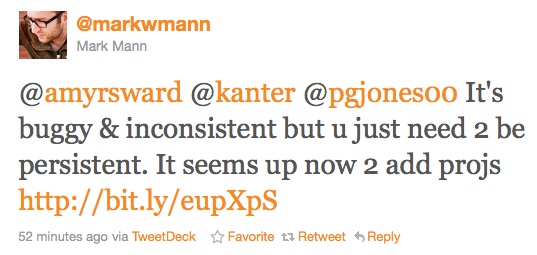
So far, trying to navigate the site to browse or set up a profile has about a 50/50 chance of hitting either a 504 or 500 error page. It’s been quite a frustrating process, especially when inputting 33 different countries one by one in the “where we work” section just to have the “save” not work. Complaining about the errors on Twitter along with @Kanter, @pgjones00 was Mark Mann:
undefinedIt is in beta, let’s not forget! So, patience and persistence are the keys to success. I’m always the first to admit I’m not patient, but I persistence this morning has gotten me pretty deep into the site – so keep refreshing your browser and you’ll get through!
Facebook Requirements
It seems that you have to have an organizational presence on facebook in order for the project page on Jumo to work/look right – I put in my facebook ID, thinking it was verifying my association as the admin on the organizational account, but instead it put my photo and info as the organization’s! I’m not sure that organizations will want to maintain, or create, a profile on facebook just as a ticket to using Jumo. Is this experience correct – have others found this to be true?
Transparency
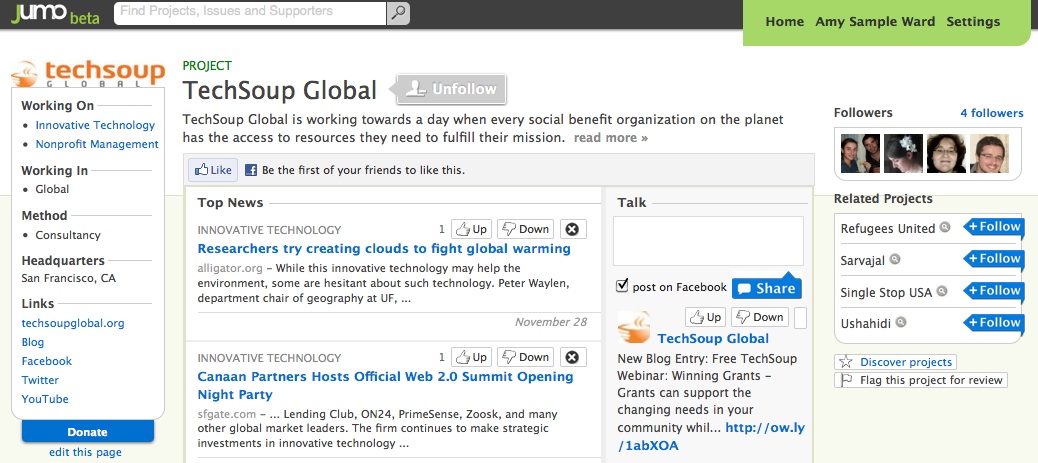
Here’s the screen shot for the TechSoup Global page on Jumo. I am following the organization and am an administrator on the page – doesn’t appear to show either of those facts!

I’m also not finding any way to customize the URL so that users could more easily find, and I could more easily share/promote the page.
Messaging
I’ve had quite a string of issues with the messaging in Jumo. Here are some of the posts I’ve shared this morning with members of a social media for nonprofits group in facebook:
  • when I try posting on people’s pages, it doesn’t appear to go through, but then they say they get 4 emails telling them about it (this is what one contact reported after I posted on his wall); when I tried posting an update on my own page it went through twice! Just checked back and Jumo deleted the second/double post but the diction is very strange! “Amy Sample Ward wrote on her/her profile:”
  • I just posted on Beth’s wall on jumo and left the “post to facebook” box checked to see if it would post on her or my facebook wall as well, but it doesn’t seem to have done so.
  • Also interesting, that it let me post on Beth’s wall (if the Jumo terms use “wall”) even though we weren’t following each other. Could mean that users don’t have a way to manage the amount of posts (read: spam) that could get through to them…
  • I got an error that said only letters, spaces and punctuation were allowed… no numbers?!
Avi Kaplan shared some feedback on my facebook wall this morning, as well:
I really agree with Avi – there doesn’t seem to be a way to comment on someone’s post to reply, or to reply to the news items. Isn’t that the point? Not just to broadcast, but to have a conversation, share ideas, and provide context.
Building a Network
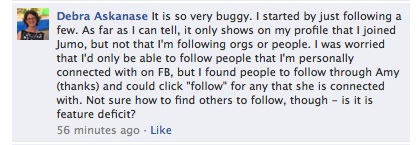
As Debra Askanse posted in a facebook group discussing Jumo this morning, how do follow people, and not just organizations?

The reason a site for finding and following causes you care about has social features is because it isn’t just the organizations we care about that we like to follow, but also the people we care about. If a friend or family member donates to an organization, starts or shepherds a campaign, or shares an appeal for support, data has shown that we are more likely to listen and even take action – we trust our friends and family and listen to what they say more than just ads or mass-messages. So, finding and following the people we want to listen to should certainly be easier in Jumo!
Donations
As Marie Deatherage pointed out, “Did you see that 15% of donation goes to jumo, about 5% to network4good? That’s the default.” As an administrator on an organization’s page, I find it interesting that it doesn’t share these details with you during the set up process. You would need to seek out the details to find out what the donation details are even though the option for people to donate through the profile is there immediately!

Purpose

As Tom Watson posted in a facebook group this morning, what’s the point?

Jumo vs Change.org – is that the question?
Change.org describes itself as:
Change.org is the world’s fastest growing social action platform, empowering people to make a difference across a variety of important causes. Our team of writers and editors provides daily coverage of breaking social action campaigns, connecting people to opportunities to get involved. We also provide free tools that allow anyone to run their own campaigns. Our tools are used by thousands of grassroots activists and organizations around the globe. We count many of the world’s leading nonprofits as partners, including Amnesty International, Sierra Club, Human Rights Campaign, and the United Nations Foundation.
So, does the nuance between the two platforms come down to “action” or something else? Organizations that I am or could follow are on both platforms, so what is the deciding factor influencing their strategy for engagement on the platform and the deciding factor for which platform I use to connect with them?
Beyond a Platform
Beyond this platform or that one, why do you, as an individual who is passionate about a cause, want to connect directly with a nonprofit organization online? Is it to take action – online? or off?  Is it to know what they are doing and how they use the funds you may have given them? Is it to see if they are worth your donations or volunteer hours? How does your purpose for engagement influence your choice of platform?
I’m really interested to hear what you all think! What are your experiences, thoughts, reactions or conjectures? What are you most curious about or hopeful for?

WikiLeaks Founder Added To The Interpol Wanted List

undefined
Two days after Internet whistleblower WikiLeaks released 251,287 U.S. diplomatic cables to major media organizations including the New York Times and Der Spiegel, international police organization Interpol has placed founder Julian Assange on its wanted list for “Sex Crimes,” in a warrant issued by the Public Prosecution Office in Gothenburg, Sweden.
While Assange might be facing criminal charges if he returns to his native Australia and is under investigation in the US for espionage, the Interpol mediated charges here are in connection with rape allegations made by two different Swedish women back in August.
While Interpol makes it clear that its infamous Red Notice list does not function as an international arrest warrant, it does serve the purpose of broadcasting internationally that the person in question is a fugitive and can aide in extradition process.
Assange, who has previously denied the allegations, is rumored to currently be hiding in the United Kingdom, which as of yet has not shown any signs of taking legal action. The @wikileaks Twitter account has remained dormant since news about the release went out.